11+ comprehension: the question types, and how to practise them at home
Comprehension is where a large share of the 11 plus English marks sit, and it is the part a worksheet helps least. Here is what the questions ask, how to answer them, how to use practice papers well, and the reading habit underneath all of it.
What an 11 plus comprehension paper looks like
Your child reads a passage, usually fiction but sometimes non-fiction or a poem, then answers a set of questions on it. The passage is longer than most children are used to reading under time pressure, and it is never from a book they know, so the skill being tested is reading something unfamiliar closely and quickly.
The format depends on the test. GL Assessment’s English test usually asks the comprehension questions as multiple choice, marked on an answer sheet. Other tests, including CSSE’s in Essex and most independent schools, ask for written answers, some of a sentence or two and some longer. Whether a writing task is set at all varies too, and so does the weight English carries against the other subjects. Confirm the current arrangements with the admissions authority, and see what the 11 plus is and who sits it for the wider shape of the eleven plus.
The other half of 11 plus English is technical: spelling, punctuation, grammar and vocabulary, usually tested by spotting the mistake in a sentence or choosing the word that fits. That half is made of small repeating patterns, so short daily practice works on it, and what 11 plus English tests, question type by question type covers it in detail. This post is about comprehension.
The four 11 plus comprehension question types
The questions climb in difficulty, and four kinds come up again and again. They need different things from a child.
- Retrieval. The answer is stated in the passage: “What time did the train leave?”, “Find two things Sam took with him.” The only skill is going back and finding it rather than trusting memory.
- Vocabulary in context. What a particular word means in that sentence, which is often not its most common meaning: “Which word is closest in meaning to ‘reluctantly’ as it is used in paragraph two?”
- Inference. Why someone acted as they did, or what a detail implies: “Why do you think Mia hid the letter?” The answer is not written down, but it has to be supported by something that is.
- Writer’s technique. How a passage is built to create an effect, and why a particular word or image was chosen: “How does the writer make the storm sound frightening?”
Retrieval questions are the ones children rush and lose marks on. Inference is the one that separates papers, and it is the one that comes from reading rather than from practice.
How to answer 11 plus comprehension questions
A method helps most on the questions children find hardest, and it is the same whether the answers are multiple choice or written.
- Read the whole passage once for the story before looking at the questions. Knowing what happens makes every later question quicker.
- Read the question, then go back to the passage. Find the line it is about and read the sentences either side. Never answer from memory, which is the mistake nearly every child makes.
- For a word question, try each option in the sentence. The right answer still makes sense there; a meaning that is right for the word in general often does not.
- For an inference question, find the evidence first. If no line in the passage supports an answer, it is the wrong answer, however reasonable it sounds.
- In written answers, use the passage’s words as evidence. A short quotation, then a sentence saying what it shows, earns more than a long answer with nothing from the text in it.
The second most common mistake is treating a word they half know as a word they know. Both habits are fixed by reading rather than by more questions.
How to use comprehension practice papers
Practice papers teach the format, and the format is worth knowing so that “find a word in paragraph two that means the same as” is not a surprise on the day. They do not build the underlying skill, which is why doing more of them stops helping quite quickly.
Start them in the second half of Year 5, once the reading habit is in place. One timed comprehension a week or fortnight is plenty, and our free comprehension practice paper is one to start with: a passage of about 950 words and 25 questions, with every answer explained. Mark it together, and spend the time on the questions that went wrong: go back to the passage and find the line that held the answer. That conversation is worth more than the score, and it is what the comprehension in 11+ Daily writes down for every question: each explanation points back to where the answer was, and why the tempting wrong option was wrong. Our post on 11 plus exam papers covers where papers come from and how many to do in all.
Where comprehension actually comes from
Comprehension is built by reading widely and talking about what was read. That is not a way of avoiding practice. It is the practice. A child who reads for twenty minutes a day and then spends five minutes talking about it, “why did she lie to him?”, “what does ‘reluctantly’ tell you?”, “how did the writer make that bit scary?”, is doing inference every day.
Vary what they read: a novel, a newspaper article, a poem, a non-fiction book about something they like. The passage in the exam will not be a book they have read, so breadth beats depth.
The writing task, where one is set
Where a writing task is set, it is usually a short piece, either a story from a prompt or a piece of persuasive or descriptive writing, marked for ideas, structure, sentence variety and accuracy. Writing is built by writing. There is nothing that substitutes for it.
One piece a week is plenty. Twenty to thirty minutes, planned first, then one round of improvement: pick a single thing to make better, such as varying sentence openings or checking every full stop, rather than correcting everything. A child who is told twelve things will remember none of them. The feedback matters more than the volume. It does not need a tutor, but it does need someone reading the piece and naming one thing.
Vocabulary runs through all of it
Vocabulary decides whether a passage is readable at all, and it runs through Verbal Reasoning too, where the word-meaning question families depend on it directly. It is built in two ways, and children need both. Reading supplies words in context, which is how meanings stick. Deliberate learning supplies the words a Year 5 child would not otherwise meet: a few new words a day, each used in a sentence, revisited a few days later and again a week after that. Do not do a hundred words at once. It feels productive and it does not last.
A home routine that holds
- Daily: read. Twenty minutes, any format, followed by a short conversation about it. This is the foundation of comprehension and vocabulary, and it is not optional.
- Most days: a few minutes of vocabulary or spelling. Short, repeated, spaced, and rotated with a few technical English questions so the mistake-spotting formats stay familiar. This is the rotation 11+ Daily plans for you: how the Today screen picks each session.
- Weekly or fortnightly, from the second half of Year 5: one timed comprehension, marked together.
- Weekly, where a writing task is set: write. One planned piece, one thing to improve, one person reading it.
- Do not do everything every day. How much 11 plus practice a child needs each day covers the overall load, and English has to fit inside it alongside the other subjects.
Comprehension and the English around it, planned and marked
The reading is the foundation. What is hard to keep up at home is everything around it: finding passages, marking them with the text open, and fitting vocabulary, spelling and grammar into the same week.
11+ Daily does those parts. Its comprehension is a passage of fiction, non-fiction or poetry with multiple choice questions on it: facts to find, words in their sentence, inference and the writer’s choices. Your child answers the set, can change any answer, then submits and sees each one marked with an explanation. Three of those questions are worked through on a real passage. There is no creative writing; the reading skills carry over to written answers. The Today screen fits comprehension in among the vocabulary, spelling and grammar skills, and the parents area shows accuracy by skill. Start your free 14-day trial, every subject unlocked and no card needed.
Try two questions from the app
One English and one Maths. Choose an answer and you will see what your child sees: whether it is right, and why.
Synonyms
What is the SYNONYM (same meaning) of:
THRIVE
Fractions of Amounts
Choose the correct answer.
A farmer has 60 eggs. He sells 3/5 of them at the market. How many eggs does he sell?
Last updated 26 October 2026.
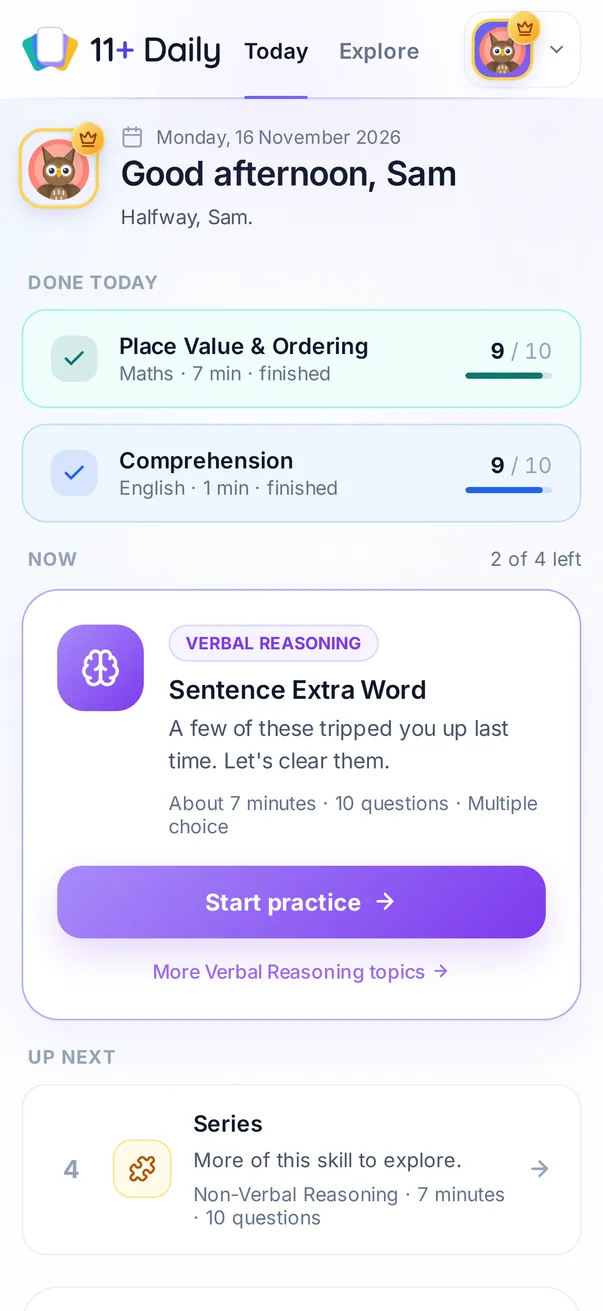
Try 11+ Daily with your child.
11+ Daily gives your child 11 plus comprehension passages of fiction, non-fiction and poetry, each answer explained against the text, plus short daily vocabulary, spelling and grammar.
14 days free, no card. Then £9.99 a month if you carry on.