How much 11+ practice should a child do each day? An honest answer for UK parents
Parents hear everything from five hours a week to two hours a day, and some are told to start mock papers in Year 4. Most of that is too much for most children. Here is a plain answer by stage, and how to build a routine that survives a school week.
A note on timing
In most grammar school areas, Kent and Buckinghamshire among them, the 11 plus (the eleven plus) is sat in September, at the start of Year 6. That means the real preparation window closes at the end of Year 5 and the summer holiday that follows. Independent schools usually set their own tests later in Year 6, and the Gloucestershire FSCE test is sat at the end of Year 5, on Saturday 3 July 2027 for September 2028 entry. The figures below assume a September test; if your child's is earlier, bring the plan forward, and confirm the current dates with your admissions authority.
The short answer
The right amount of daily 11 plus practice is the largest amount your child will keep up without dreading it, within the range for their stage. Consistency matters more than intensity. If the test itself is new to you, start with what the 11 plus is. As a guide:
| Stage | Daily practice | Frequency |
|---|---|---|
| Year 4 (age 8 to 9) | 10 to 15 minutes | 4 to 5 days a week |
| Year 5, first half (Sept to Feb) | 15 to 25 minutes | 5 to 6 days a week |
| Year 5, second half (Mar to summer) | 25 to 35 minutes plus a monthly mock paper | 5 to 6 days a week |
| Final month before the test | 30 to 45 minutes plus weekend mock papers | 6 days a week |
These are not hard rules. A focused, willing child can do less. A reluctant child probably should not do more. What matters most is not minutes per day but whether the practice happens, week after week.
Two kinds of 11 plus practice (and why parents conflate them)
- Daily skill practice. Vocabulary, spelling, grammar, mental maths and, where the test has them, the verbal and non-verbal reasoning question types. Short and frequent. This is where consistency matters most.
- Full practice papers. A long sitting at a table, marked afterwards, to train pace and stamina. Far less often: about monthly through the second half of Year 5, weekly in the final month.
Mixing them up is the most common mistake. Two-hour weekend sessions of full papers from the start of Year 5 get the paper count right and the consistency wrong. Fifteen minutes of skill practice every weekday, with one mock paper a month from the spring, is usually the better plan.
Year 4: exposure, not mastery
Year 4 is early for serious 11 plus preparation, but a sensible time to start light, regular practice. The goal is familiarity with the question types, not mastery. Ten to fifteen minutes a day, four or five days a week, is plenty.
The trap is starting with the heaviest material: full mock papers, long weekly sessions, formal tutoring. A child who is put off in Year 4 is hard to bring back in Year 5. Keep the relationship with practice positive.
Year 5, first half (September to February): building the habit
The start of Year 5 is when daily practice should become a real habit. The work is still the underlying skills, not exam technique: vocabulary, spelling, Key Stage 2 maths and, if the test has them, the reasoning question types. Fifteen to twenty-five minutes a day, five or six days a week, suits most children.
Short daily sessions are worth more than long weekend ones here, because the skills build on each other over the months that follow.
Year 5, second half (March to summer): extending and consolidating
From around March, practice steps up to twenty-five to thirty-five minutes a day for most children. This is when knowing exactly what is weak becomes useful: "shaky on fractions" is a worry, but "keeps missing fractions of amounts and letter series" is a plan. The 11+ Daily parents area shows accuracy by subject and by skill, so you can see this without marking anything yourself.
Mock papers matter from this point, but not every week. One full paper a month is plenty through the spring and summer term, as a checkpoint rather than the main event.
Final month before the exam: timing and exam fitness
For a September test this is usually the August holiday. It is the one window where heavier practice helps. Thirty to forty-five minutes of daily skill practice continues, and a full mock paper most weekends becomes useful. The goal shifts to exam fitness: pacing, stamina, the test's answer format, and moving on from a question your child cannot answer without losing the next five.
It is also when over-practising becomes a real risk. A child who arrives at the test tired does worse than one who arrives fresh. If you see signs of burnout, do less.
Why consistency beats intensity
Skills practised in short, regular sessions are remembered. Skills crammed into long, occasional sessions are mostly forgotten by the next one. That is as true of the 11+ as of learning an instrument.
The other reason is that the limiting factor in most homes is rarely "not enough content". It is "we did not sit down to do it tonight". A ten-minute session that happens is worth more than an hour that does not. What counts is the share of school weeks in which the practice actually happens.
How to build a daily habit that survives weeknights
- Same time, same trigger. After dinner, before screen time, on the way home. Children settle into routines fastest when the cue is the same.
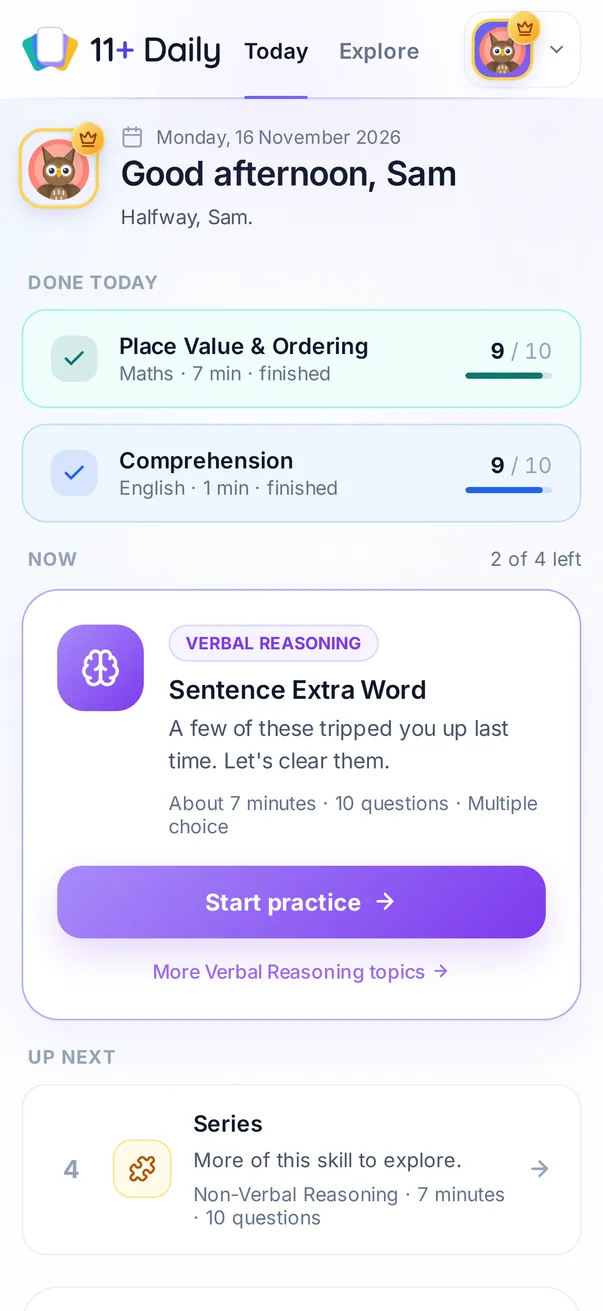
- Remove the decision. If practice means choosing a book, finding the page and getting a pencil, most weeknights it will not happen. Either prepare the materials in advance or use something that decides for you. That is what the Today screen in 11+ Daily does: it picks the subject and skill each time your child opens the app.
- A short session is enough on a tired day. It keeps the routine alive. Skipping a day "because there was no time for a proper session" is how habits break.
- Keep weekends lighter, not heavier. Small weekday sessions plus a big weekend session usually ends with both skipped. Weekday consistency with a slightly longer Saturday lasts better.
- Make wrong answers useful. Practice with feedback beats practice without it. Build in a way to revisit questions your child got wrong, ideally a few days later.
Warning signs you are doing too much
- Your child resists practice they were happy to do a month ago.
- They rush through questions to "get it over with".
- They get upset before or during sessions.
- Their practice scores fall as the workload rises.
- You are adding work because of other parents, not because your child needs it.
In each case, scale back rather than push harder. Burnout before the test is avoidable.
A daily routine that plans itself
The hard part of this plan is deciding, every evening, what to practise, and keeping track of what keeps going wrong. 11+ Daily does that part. Each time your child opens it, the Today screen picks one subject and one skill, based on what is weak and what has not been practised for a while. A session takes about seven to ten minutes, and there is always more when your child wants it. Wrong answers come back until they are right, and the parents area shows days practised, skills covered and accuracy by subject and skill. It has no full timed mock papers; it is the daily skill practice the mocks sit on top of. It works in the browser on a laptop, tablet or phone, and in the apps. Start your free 14-day trial, every subject unlocked, no card needed.
Try two questions from the app
One English and one Maths. Choose an answer and you will see what your child sees: whether it is right, and why.
Synonyms
What is the SYNONYM (same meaning) of:
THRIVE
Fractions of Amounts
Choose the correct answer.
A farmer has 60 eggs. He sells 3/5 of them at the market. How many eggs does he sell?
Last updated 1 May 2026.
Try 11+ Daily with your child.
11+ Daily plans each day's practice for you: the Today screen picks one subject and one skill for a session of about seven to ten minutes, with more there when your child wants it.
14 days free, no card. Then £9.99 a month if you carry on.