Should my child sit the 11+? How to decide in Year 5
Somewhere in Year 5 the question stops being hypothetical: should your child sit the 11 plus at all? Nobody can answer it for you, and nobody can tell you in advance how your child will do. What you can do is understand what the decision actually involves, look honestly at your child, and make a choice you are comfortable with either way.
What deciding on the 11 plus really involves
Deciding whether your child should sit the 11 plus feels like one enormous choice. In practice it is two smaller ones, made about a year apart. The first, in Year 5, is whether to register your child for the test. The second, in the autumn of Year 6, is which secondary schools to put on your application form.
Registering is not committing. It keeps the option of a grammar school open and nothing more. In most grammar areas you register your child yourself, and in a few, children at local state primaries are entered automatically unless a parent opts out. Either way, you can usually change your mind before the test, though the rules on withdrawal vary, so check them with the admissions authority.
The school choice comes later. In England you apply for a secondary place through your home local authority’s common application form, normally by 31 October of Year 6, listing your preferences in order. In most grammar areas, results arrive before that deadline, so you choose with the result in hand. Confirm the current arrangements with the admissions authority, because dates and processes differ between areas. Our plain guide to what the 11 plus is and how it works covers the background.
When the decision has to be made
The deadline that matters in Year 5 is registration. In many grammar areas it opens in the late spring or early summer of Year 5 and closes before the school year ends, which is why it is so easy to miss. A few areas run a different calendar: the Gloucestershire FSCE test, for example, is sat at the end of Year 5 from 2028 entry, so everything comes earlier there. Our guide to which 11 plus your area uses shows how to find the admissions authority and what it publishes.
So the useful moment to think this through is the autumn or spring of Year 5, while there is still time to start gently if you go ahead, and before a registration form arrives with a deadline attached. Our list of 11 plus registration and test dates for 2027 shows what each area has published so far. Confirm the current registration dates with the admissions authority for the year your child applies.
Signs the 11 plus may suit your child
Nobody can tell you in Year 5 how your child will score. What you can look at is fit: whether the preparation and the school are likely to suit the child you have.
Some signs point towards having a go:
- A reading habit. Children who read for pleasure tend to build the vocabulary and comprehension that English and Verbal Reasoning lean on, without it feeling like work.
- Enjoying a challenge. A child who likes puzzles, asks for harder problems or is happy to be stuck for a minute usually finds practice less of a battle.
- Coping with pressure. Not being calm about everything, but being able to have an off day and come back to it.
- Interest in the school itself. A child who has seen the school and liked it brings their own reason to the table, which matters more than yours.
None of these is a requirement, and plenty of children who sit the eleven plus show only some of them.
Signs it may be worth pausing
The other side deserves equal weight. Reasons to think carefully include:
- The journey. A grammar school can be much further away than the local secondary. Five years of a long bus ride, early starts and friends who live across the county are part of the decision, not a detail.
- The school’s ethos. Visit on an open day and ask yourself whether your child would be happy there, not just whether they could get in. Some children thrive in a fast-paced, academic setting; others do better elsewhere.
- Existing anxiety. If schoolwork is already a source of worry, a year of test preparation can add to it. That is not an automatic no, but it calls for a lighter approach and an honest check-in along the way.
- Your family’s capacity. Preparation needs a parent’s time and attention most days. If this year is already stretched, that is a fair thing to weigh.
Talking to your child and the class teacher
Ask your child, in plain terms, what they think. Explain that it is a test some schools use, that preparing means a little practice most days, and that whatever happens there will be a secondary school place for them. Their answer will not settle it, because ten-year-olds are not in charge of school applications, but a child who is curious will find the year easier than one who feels pushed.
The class teacher is worth a short conversation too. Ask how your child approaches work they find hard, how they cope with timed tasks, and whether anything at school suggests a reason for caution. Teachers are often careful about commenting on the 11+ itself, and some schools have a policy on it, so frame the questions around your child rather than asking for a verdict.
The real cost of preparation is time
Families often think about the cost of the 11 plus in money: tutors, books, mock papers. The bigger cost is time, most days, for most of a year. A sensible pattern is 15 to 25 minutes a day through the autumn and spring of Year 5, rising in the summer term, which our guide to how much 11 plus practice a child needs each day sets out stage by stage.
That is modest on any one evening, but it adds up across a year, and it competes with clubs, friends and rest. Our Year 5 11 plus plan, term by term shows how the time is spread. If you can picture that rhythm fitting into your week without constant friction, that is a good sign. If you cannot, it is worth knowing before you start.
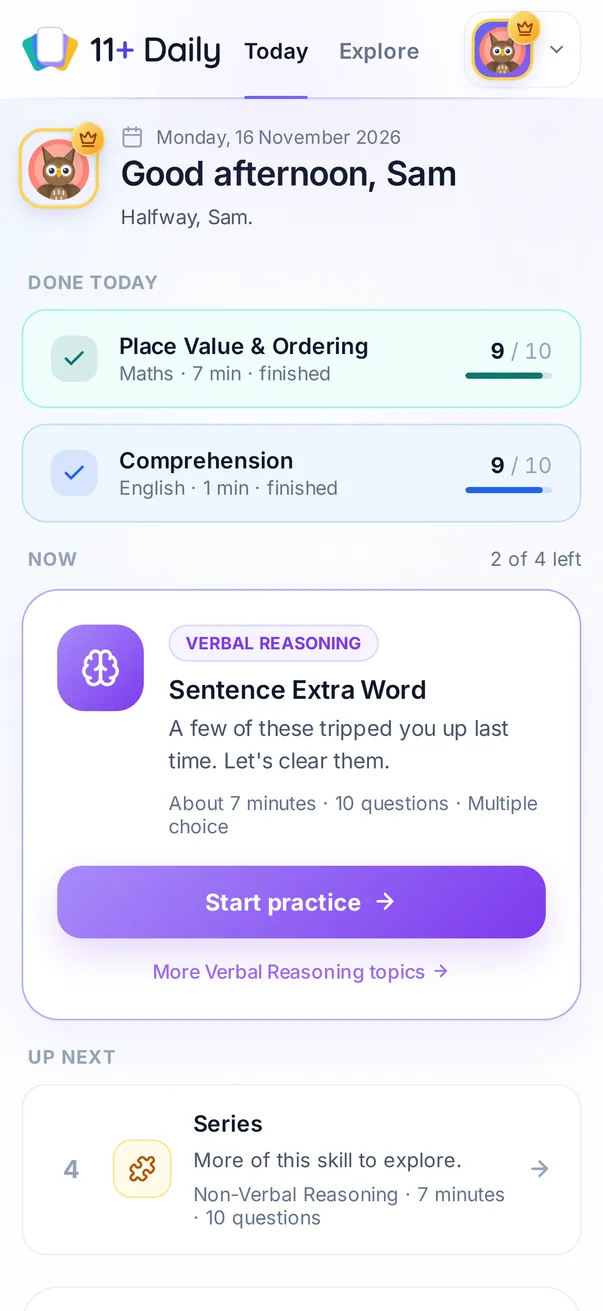
Much of a parent’s share of that time goes on deciding what to practise next and checking it happened. 11+ Daily does that part: the Today screen picks each session, and the parents area shows what was done.
If your child does not get a grammar place
This is the part to settle in your own mind before deciding, because it shapes how the whole year feels. Most children in grammar school areas go to non-selective secondary schools. Every child who applies on time through the common application form is offered a secondary place.
The practical step is to put a non-selective school you would genuinely be happy with on your form, alongside any grammar school. Visit it with the same care. A child who knows there is a good option either way can sit the test without feeling that everything rides on it. Many areas also have an appeals process; the admissions authority publishes the details.
A decision you can live with either way
The right answer is the one you would be comfortable with whatever the result. Register if the school and the year of preparation both suit your child, knowing you can still change course. Pause if the journey, the ethos or the pressure feels wrong. Either way, decide in Year 5, before the registration deadline decides for you.
Trying the daily routine before you decide
The question underneath this decision is often whether a year of practice will fit your family. You can find that out in a fortnight rather than guessing.
11+ Daily gives your child short sessions, already planned. The Today screen picks one subject and one skill, based on what is weak and what has not been practised for a while, and wrong answers come back until they are right. Sessions take about seven to ten minutes, with more there when your child wants it. The parents area shows days practised, skills covered and accuracy by subject and skill, so you can see how it is going without quizzing your child. It works in the browser on a laptop, tablet or phone.
Start your free 14-day trial, with every subject unlocked and no card needed.
Try two questions from the app
One English and one Maths. Choose an answer and you will see what your child sees: whether it is right, and why.
Synonyms
What is the SYNONYM (same meaning) of:
THRIVE
Fractions of Amounts
Choose the correct answer.
A farmer has 60 eggs. He sells 3/5 of them at the market. How many eggs does he sell?
Last updated 28 October 2026.
Try 11+ Daily with your child.
11+ Daily gives your child short sessions, already planned, and shows you what was practised, so you can see how a year of 11+ preparation fits your family before you commit.
14 days free, no card. Then £9.99 a month if you carry on.