11+ maths topics: the full list, strand by strand
There is no separate 11 plus maths syllabus. The nearest thing is the Key Stage 2 national curriculum, and this page lays it out as a checklist: every topic, what a question on it asks, and the year your child's school is meant to teach it.
Where the 11 plus maths topics come from
Parents searching for an 11 plus maths syllabus usually find that none exists. The organisations that set the eleven plus write their papers from the Key Stage 2 national curriculum for England, the same document your child’s school teaches from, and they do not publish a list of their own. That is useful: the curriculum is public, and it says which year each topic belongs to.
The tables below take that curriculum strand by strand. Each row gives a topic, a plain description of what a question on it asks, and the year or years in which the national curriculum teaches it. Every topic links to a practice page with worked examples.
Two caveats. The years are what the curriculum says; some schools teach a topic earlier or later. And this is a reference list, not a preparation guide: for how one paper asks these topics and how to practise them, see our guide to GL 11 plus Maths.
Year 5 or Year 6: check when your test is sat
The year column matters because of when the test falls. A test sat in September of Year 6 comes after Year 5 and only a few weeks of Year 6, so it may reach some Year 6 content. A test sat in the summer of Year 5, such as the Gloucestershire FSCE test, sat at the end of Year 5, is likely to stop at Year 5.
Several strands sit almost entirely in Year 6, ratio and algebra above all. Whether they can appear on your child’s paper, and how far, is a question for your admissions authority, which often publishes familiarisation material. Confirm the current arrangements with them rather than relying on a forum post. Our guide to which 11 plus your area uses explains who sets the test where.
Number and place value
| Topic | What a question asks | Taught in |
|---|---|---|
| Place value and ordering | What a digit is worth, writing a number from words, ordering and rounding whole numbers | Years 3 to 6, numbers to a million in Year 5 |
| Negative numbers | Counting past zero in temperatures, depths and balances, and the gap across zero | Years 4 to 6 |
| Roman numerals | Reading and writing numbers and years in Roman numerals | Years 3 to 5, up to M in Year 5 |
| Estimation and approximation | Rounding first to find a quick answer, and judging whether an amount is sensible | Years 3 to 6 |
The four operations
| Topic | What a question asks | Taught in |
|---|---|---|
| Four operations and BODMAS | Choosing the right calculation for a short problem, and doing steps in the right order when there are brackets | Years 3 to 6, order of operations in Year 6 |
| Number properties | Spotting multiples, factors, primes, squares and cubes among a set of numbers | Years 4 to 6, primes, squares and cubes from Year 5 |
Times tables up to 12 times 12 are expected by the end of Year 4. They are not a topic on the paper so much as the ground under every topic on it.
Fractions, decimals and percentages
| Topic | What a question asks | Taught in |
|---|---|---|
| Fractions: basics and equivalents | Whether two fractions are equal, simplifying, and putting fractions in order | Years 3 to 6, simplifying in Year 6 |
| Fractions of amounts | Finding a fraction of a quantity, in pounds, millilitres or objects | Years 3 and 4, in harder problems after |
| Fractions of shapes | Reading the fraction shaded on a drawn shape or grid | From Year 1, with diagrams of equivalent fractions in Years 3 and 4 |
| Decimals | Comparing, ordering, rounding and calculating with decimals | Years 4 to 6 |
| Percentages | Finding a percentage of an amount, or working out what percentage one amount is | Years 5 and 6 |
| FDP conversions | Turning a fraction, decimal or percentage into another form, or picking the largest of three | Years 4 to 6 |
Ratio and proportion
| Topic | What a question asks | Taught in |
|---|---|---|
| Ratio and scaling | Sharing a total in a ratio, working back from one share, scaling a recipe or a map | Year 6, simple scaling from Year 3 |
Ratio and proportion is a Year 6 strand in the curriculum. On a test sat early in Year 6, it may be one of the topics your child has met least in class.
Algebra
| Topic | What a question asks | Taught in |
|---|---|---|
| Sequences and patterns | Finding a missing term in a number or shape sequence, or the rule behind it | Counting in steps from Year 1, describing linear sequences in Year 6 |
| Function machines and inverse | Working a number through a chain of operations, forwards or backwards | Inverse operations from Year 2, simple formulae in Year 6 |
| Equations and missing numbers | Finding the number a letter or symbol stands for, or the expression that describes a situation | Missing number problems from Year 1, writing them with letters in Year 6 |
| Inverse and think of a number | Running “I think of a number” puzzles backwards to find the start | Inverse operations from Year 2 |
As a named strand, algebra appears only in Year 6. The thinking behind it, undoing an operation to get back to the start, is taught much earlier.
Measurement
| Topic | What a question asks | Taught in |
|---|---|---|
| Units and conversion | Converting between grams and kilograms, metres and kilometres, litres and millilitres | Years 4 to 6 |
| Money | Change, unit prices, saving towards a target and comparing ways of paying | Years 2 to 4, then inside word problems |
| Time and timetables | Clock times, durations and reading a printed timetable | Years 3 to 5, timetables in Year 5 |
| Perimeter, area and volume | Choosing which of the three a question wants, and working it out in the right units | Years 3 to 6, triangles and volume of cuboids in Year 6 |
Geometry and shape
| Topic | What a question asks | Taught in |
|---|---|---|
| 2D shapes and properties | Naming a shape from its sides, angles and symmetry | Years 1 to 6, classifying triangles and quadrilaterals in Year 4 |
| 3D shapes and nets | Counting faces, edges and vertices, and matching a net to its solid | Faces, edges and vertices from Year 2, recognising solids from drawings in Year 5, nets in Year 6 |
| Angles | Finding a missing angle on a line, at a point or in a shape | Years 3 to 6, degrees from Year 5 |
Position and direction
| Topic | What a question asks | Taught in |
|---|---|---|
| Coordinates and position | Reading and plotting coordinates and describing moves on a grid | Years 4 to 6, all four quadrants in Year 6 |
| Transformations | Where a shape lands after it is moved or flipped, or which move was made | Translations from Year 4, reflections from Year 5 |
Statistics
| Topic | What a question asks | Taught in |
|---|---|---|
| Bar charts and pictograms | Reading values from a chart, using a pictogram key | Years 2 to 4 |
| Line graphs and pie charts | Reading a line graph, and turning a slice of a pie chart into a number | Line graphs in Year 5, pie charts in Year 6 |
| Tables and two-way tables | Finding the right cell and calculating from it | Years 2 to 5 |
| Venn diagrams | Sorting numbers into overlapping circles by rules such as multiples or squares | Not named in Key Stage 2; the rules use number facts from Years 4 to 6 |
| Mean, median, mode and range | Finding an average or a spread from a set of numbers | Mean in Year 6; the other three are Key Stage 3 |
The last row is worth a note. Only the mean is in the Key Stage 2 curriculum. 11+ Daily covers all four, but if your child has not met the other three at school, that is expected.
Problem solving across the strands
| Topic | What a question asks | Taught in |
|---|---|---|
| Multi-step word problems | A short story with numbers and no sum written out: choosing the two or three calculations and their order | Every year, two-step in Year 4, multi-step in Year 5 |
| Classification and logic | Finding the one option that satisfies several rules at once | Number properties from Year 5, listing possibilities in Year 6 |
These two are where the strands meet, which is why they often feel harder than any single topic in them.
How to use this list
Treat it as a checklist, not a timetable. Go down the year column and mark anything your child has not yet been taught at school; those topics need teaching before they need practice. Then mark the ones that keep going wrong, and give them more of the week. Every row is a Maths skill in 11+ Daily, so that marking is done for you: the parents area shows accuracy skill by skill, and the Today screen picks each session from what is weak.
Do not drop a strand because it looks rare: nobody outside the test writers knows this year’s mix. For an order to work through the topics, see the 11 plus Maths practice hub, and for how the year fits together, our Year 5 plan, term by term.
This checklist, kept up to date as your child practises
A list of 33 topics is easy to print and hard to keep current: which are secure, which have slipped, and which have not been touched for a month.
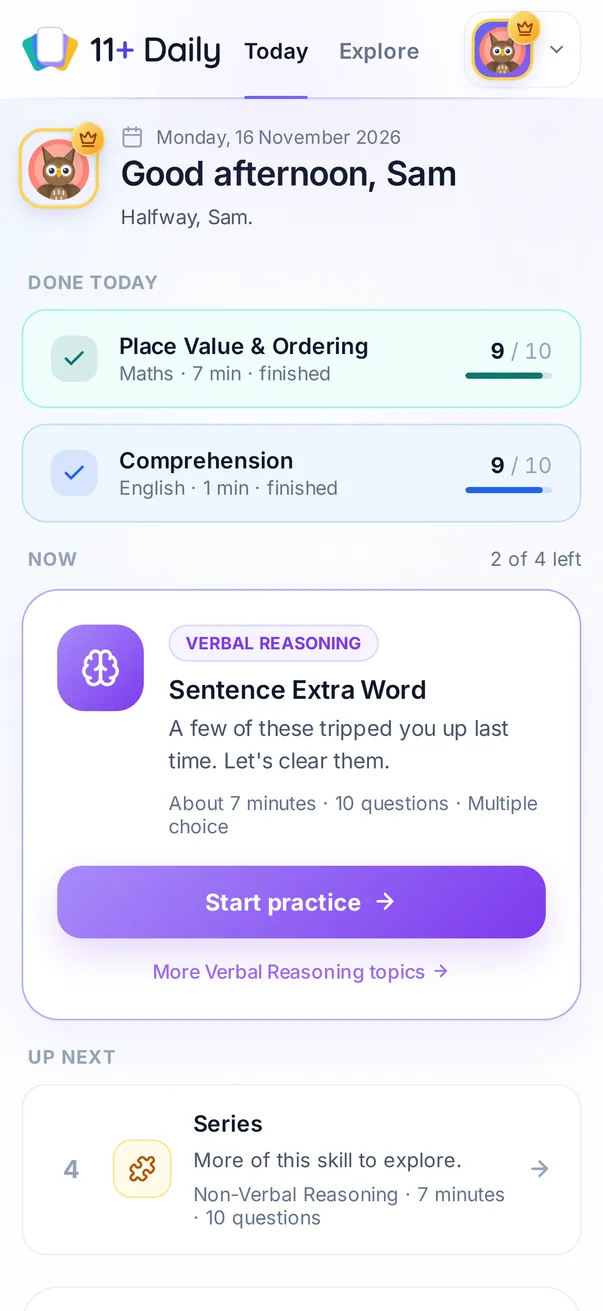
In 11+ Daily each row above is a skill. The Today screen picks one subject and one skill for each session, based on what is weak and what has not been practised for a while, and a session stays on that one topic so your child uses one method at a time. Wrong answers come back in later sessions until they are right. The parents area shows days practised, skills covered and accuracy by skill, so you can see this checklist filling in without marking anything. A session takes about seven to ten minutes, and there is more whenever your child wants it. Start your free 14-day trial, every subject unlocked and no card needed.
Try two questions from the app
One English and one Maths. Choose an answer and you will see what your child sees: whether it is right, and why.
Synonyms
What is the SYNONYM (same meaning) of:
THRIVE
Fractions of Amounts
Choose the correct answer.
A farmer has 60 eggs. He sells 3/5 of them at the market. How many eggs does he sell?
Last updated 11 November 2026.
Try 11+ Daily with your child.
11+ Daily turns this list into a plan: every topic is a skill, the Today screen picks which one your child practises next, and the parents area shows accuracy topic by topic.
14 days free, no card. Then £9.99 a month if you carry on.