Is it too late to start 11+ preparation? Starting in the spring or summer of Year 5
Plenty of families start 11 plus preparation later than the guides suggest. Whether it is too late depends on how many months are left and on the reading and maths your child already has. Here is an honest way to use the time, however much of it there is.
Is it too late to start 11 plus preparation?
Most guides, ours included, start 11 plus preparation in September of Year 5. Plenty of families find out about the test later, decide later, or move into a grammar school area halfway through the year. If that is you, the honest answer is that it depends on two things: how many months remain before the test, and what your child already brings to it.
In most grammar school areas the test is sat in September at the start of Year 6, so a family starting in the spring of Year 5 has around six months and one starting in early summer has about three. The Gloucestershire FSCE test is earlier, planned for Saturday 3 July 2027 at the end of Year 5, so there the same start leaves about two months less (see Gloucestershire FSCE 11 plus practice). Confirm the current arrangements with your admissions authority, including the registration deadline: in Kent, for example, registration for the September 2026 test closed on 1 July. Missing that date is the one thing that really is too late.
What decides how much time you need
The 11+ rests on two foundations that take years to build: reading and Key Stage 2 maths. A child who reads widely for pleasure and is quick and secure with number has most of what the test needs. What they lack is familiarity with the formats and practice at working to time, and both respond to a few months of steady work.
A child who reads little, or who is still shaky on times tables, fractions or written methods, has more to do, and a short runway will not close every gap. That is a reason to be realistic, not to give up: spend the months on what moves fastest. No plan, and no amount of practice, can tell you in advance what score your child will get.
Which plan fits
The three plans below are written for a test in September of Year 6. Pick the one that matches the months you have left, not the month on the calendar: a Gloucestershire family starting in October of Year 5 has about nine months, and one starting in March has about four, closer to the three-month plan.
A plan for about nine months
Starting around December of Year 5 for a September test, you are a term behind the usual plan and not much more. Keep the ordinary order of habit, then weak areas, then pace, and compress it slightly.
Build a daily habit straight away: fifteen to twenty-five minutes, five or six days a week, at the same time each day. Spend January and February meeting every question type your child’s test uses, so you have a first list of weak areas by March. From around March, step up to twenty-five to thirty-five minutes and add one full mock paper a month. The final month, usually the August holiday, is the time for heavier practice. Our Year 5 11 plus plan, term by term has the full shape.
A plan for about six months
Starting around March, breadth and the weak-areas list have to come together. Spend the first three or four weeks on a short session for each question type your child has not met, so you see quickly which they pick up and which they do not.
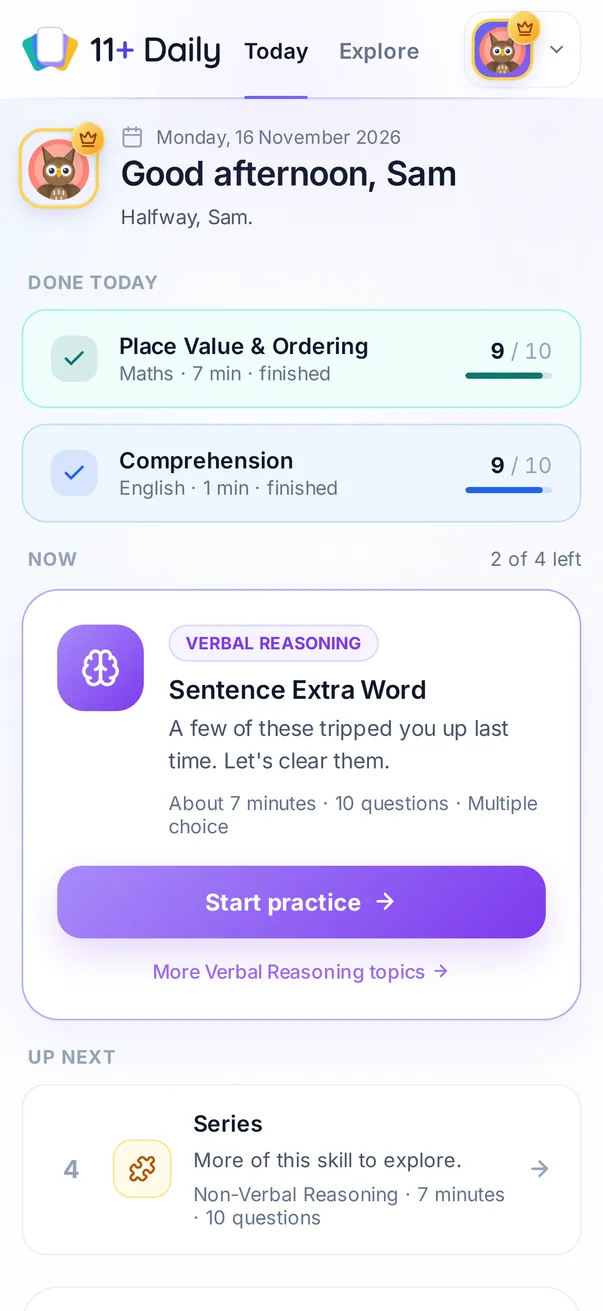
Then go to twenty-five to thirty-five minutes a day, five or six days a week, with most sessions on the weak list and a few keeping the stronger areas warm. Steering every session towards the weak list is the work 11+ Daily does: the Today screen picks the skill from what is weak and what has not been practised lately, and wrong answers come back until they are right (how the Today screen picks each session).
Add the first timed section around April and one full mock paper a month from May. Keep daily reading running alongside. The amounts in our guide to how much 11 plus practice a child needs each day are a ceiling, not a target, even when you have started late.
A plan for about three months
Starting in June for a September test, there is no time to cover everything, so choose. Spend the first week or two seeing every question type once. Then put most of the time into the short list below, in sessions of twenty-five to thirty-five minutes, five or six days a week, with one full paper a month, rising to thirty to forty-five minutes a day with a paper most weekends in the final month. Our guide to when to start 11 plus mock exams and how many to do explains how to review each one.
Three months is enough to remove surprises and practise technique. It is not enough to rebuild a weak reading habit or a year of missing maths, so work on what can move in the time and accept the rest.
What to prioritise when time is short
When time is short, these four give the most back for the minutes spent:
- Question types your child has never seen. A child meeting a letter code or a cube net for the first time in the exam loses time working out what is being asked. Seeing every format your child’s test uses once, with a worked example, removes that cost. Our practice guides by subject and question type cover each one.
- Timed technique. Working to a clock, moving on from a stuck question and coming back, and filling in an answer sheet cleanly where the test uses one, all improve with a little practice on single timed sections.
- Arithmetic fluency. Times tables and mental calculation sit underneath most maths questions and many reasoning ones. Five minutes a day of quick recall pays back across the paper.
- Vocabulary through reading. Twenty minutes of reading a day, anything your child enjoys, keeps vocabulary growing right up to the test.
What not to do
Do not cram every night. Two-hour sessions after school wear a child out within weeks, and a tired child learns less per minute than a fresh one.
Do not set a mock paper every day. A full paper measures what your child can already do; it teaches little on its own, crowds out the skill practice that does the teaching, and turns every evening into a score.
Do not let your own worry set the pace. Starting late can make a parent feel behind, and that feeling is easy to pass on. Your child does not need to know that other families started earlier.
Keeping a late start calm
Keep the routine boring and predictable: the same time, the same place, a task already chosen before the session starts. Look at accuracy on named skills rather than mock totals, because “fractions are coming on” is something a child can feel good about and a percentage often is not. Leave at least one day a week free of practice.
Watch for the signs of too much: resistance to sessions that used to be fine, rushing, tears, or scores falling as the workload rises. If you see them, scale back. In the last four or five days, ease off to a short session or nothing. The eleven plus is one test on one day, and your child’s wellbeing matters more than another week of practice.
Spending the months left on the right skills
With a late start, every evening spent deciding what to do is an evening lost. 11+ Daily takes that decision: the Today screen picks one subject and one skill for each session, from what is weak and what has not been practised lately, and shows your child why. Wrong answers come back in later sessions until they are right, and Weak Points gathers the questions your child keeps missing into one drill. The parents area shows accuracy by subject and by skill, the weak-areas list kept for you. A session is about seven to ten minutes, and there is always more when your child wants it. Where the test has no Verbal or Non-Verbal Reasoning, switch those off in Settings. Start your free 14-day trial, every subject unlocked, no card needed.
Try two questions from the app
One English and one Maths. Choose an answer and you will see what your child sees: whether it is right, and why.
Synonyms
What is the SYNONYM (same meaning) of:
THRIVE
Fractions of Amounts
Choose the correct answer.
A farmer has 60 eggs. He sells 3/5 of them at the market. How many eggs does he sell?
Last updated 4 November 2026.
Try 11+ Daily with your child.
11+ Daily decides what to practise each day when time is short: the Today screen picks the weak or neglected skill, and wrong answers come back until they are right.
14 days free, no card. Then £9.99 a month if you carry on.