11+ scores explained: how the score is calculated
Depending on where you live, your child's 11 plus result arrives as a standardised score or as a position in each school's ranking. Here is how both are worked out, the adjustments schools make beyond age, and how each turns into a place.
11 plus scores explained
Your child’s 11 plus result depends on where you apply. In some areas it is a standardised score, where 100 is the average for children of the same age. In others, families are not given a score to interpret at all: each school ranks everyone who applied and tells you where your child came.
Both start the same way. Every paper is marked, adjusted for age and combined into a total. What differs is what you are told, and what happens next: every school applies its own admissions criteria, which can move a child up or down its list for reasons that have nothing to do with the test. This guide covers both, and ends with the questions to check for your own area. If the exam itself is new to you, start with what the 11 plus is and who sits it.
How is the 11 plus marked?
The 11 plus is marked by the test provider, not by your child’s primary school. The first number it produces is the raw mark: how many questions your child answered correctly on each paper.
Raw marks are hard to compare for two reasons. A child born in September is almost a year older than a classmate born the following August, and at ten that is a real difference. And one paper may be harder than another sat the same morning. Standardising deals with both.
How is the 11 plus score calculated?
The 11 plus score is calculated in three steps, whether or not you ever see it.
The raw mark. Each correct answer adds to the raw mark for that paper or section. It is the only step that depends on what your child puts on the answer sheet, and the only one practice can change.
Age standardisation. The provider compares each raw mark with the marks of children of the same age, in years and months, who sat the same paper. On the usual scale the average is 100 and about two thirds of children land between 85 and 115. Two children with the same raw mark can get slightly different scores, and the younger one gets the higher. It is a correction, not a bonus.
Combining the papers. The paper scores are added together, sometimes weighted so one subject counts for more. Buckinghamshire weights verbal skills at 50% and maths and non-verbal skills at 25% each, and Medway counts English and maths twice and reasoning once.
What you are told: a score or a position
What families receive depends on the area, and sometimes on the school. There are two broad kinds of result.
A score. Kent, Buckinghamshire, Medway, Lincolnshire, Essex and the Birmingham grammar schools all send a standardised score or total. It is not out of a fixed number: in Kent, the council says each of the three scores runs from 69 to 141, so the highest possible total is 423, while Buckinghamshire’s single combined score falls between 60 and 170. Totals are on different scales from area to area, so compare a score only with its own area’s published figures.
A position in a ranking. Some schools never give families a number to interpret. The Gloucestershire grammar schools rank everyone who applied and tell families whether their child met each school’s qualifying standard and where they were placed. Sir Thomas Rich’s School puts it plainly: the total “is used to place applicants in a rank order by which places are allocated. This is not a pre-defined pass mark.”
Even where you are sent a score, many schools then rank the children who reach it, so a score is often just the first step towards a position on each school’s list.
How a result turns into a place
A result is read against a line, a list, or both.
A fixed qualifying score. Every child at or above it qualifies, and the school’s other rules decide who is offered a place. Buckinghamshire’s is 121, and a higher score gives no extra priority.
A line set each year. Kent and Medway draw the line after the test, so the number moves with each year’s results.
Rank order. Places go down the school’s list until it is full. A position inside the number of places, after the school’s priority groups, leaves room for your child even if every child above them puts that school first: Sir Thomas Rich’s, for example, offers a place to children ranked in its top 155 who name it as their first preference. Below that, offers depend on everyone else’s choices. Most families name several schools and can take only one place, so as the most popular schools fill, other schools’ offers reach far further down their lists. The same position can be inside one year and outside the next.
The adjustments are not just age
Age standardisation is the same for everyone. After it, every school applies its own admissions policy, and that can matter as much as the test. These are the adjustments to look for, wherever you are:
- Looked after and previously looked after children come first in every state school’s rules once they meet the standard.
- Pupil premium. Many grammar schools give priority to children eligible for the pupil premium, and some set them a lower qualifying standard: Reading School and Kendrick set it five points lower, and the Gloucestershire grammar schools set a lower one too.
- Where you live. Many schools favour children in a catchment, priority area or set of postcodes, sometimes at a lower standard. Denmark Road High School gives children in the GL1 to GL4 postcodes a lower “Priority Standard”; the Birmingham King Edward VI schools give catchment priority to children who reach a higher score; Essex schools’ last offers differ inside and outside their priority areas; and Medway assesses children at its own schools differently from those outside it.
- Siblings and staff. Some schools give priority to brothers and sisters of current pupils, or to children of staff.
- Special educational needs and disability. A child whose education, health and care plan names the school is admitted. Access arrangements, such as extra time or a modified paper, are requested when you register for the test.
- A second look. Some areas look again at children just below the line: Kent’s headteacher panel considers extra evidence, and any child refused a place can appeal to an independent panel.
- Tie-breaks. Where two children are level, many schools decide by distance from home.
The order is different at every school and can change from year to year, so the only safe source is each school’s admissions policy for the year your child applies.
What to check for your area
Whichever area you are in, these questions cover what decides a place. The answers are in the admissions authority’s and each school’s published arrangements:
- Which papers are sat, and are any weighted more than others?
- Will you be sent a score, a qualified or not qualified result, or a position on each school’s list, and when?
- Is there a fixed qualifying score, a line set each year, or rank order?
- Which priority groups come first, and does any have a lower standard?
- Does where you live, or a sibling at the school, change the order?
- How do your preferences interact if your child qualifies for more than one school?
- What happens if your child is just below the line: a review, a panel or an appeal?
How the main areas use the result
These are the arrangements published for September 2027 entry. They change, so confirm the current arrangements with the admissions authority before relying on a figure.
| Area | What families are told | How places are decided |
|---|---|---|
| Kent | Three scores, English, maths and reasoning, each 69 to 141 | An aggregate and a minimum per paper, set each year; a headteacher panel considers some children below it |
| Medway | A weighted score: English and maths count twice, reasoning once | A minimum weighted score set each year, 478 for 2027 entry |
| Buckinghamshire | One score, 50% verbal, 25% maths, 25% non-verbal | 121 qualifies; above it, the school’s other rules decide |
| Birmingham (King Edward VI) | A combined score centred on 200 | A qualifying score of 205, then pupil premium, catchment and rank order |
| Lincolnshire | Verbal and non-verbal reasoning scores, equally weighted | A combined 220 or above qualifies |
| Essex (CSSE) | A total of English and maths, weighted equally | No offer below 303; schools rank above it |
| Gloucestershire grammar schools | Whether your child met each school’s qualifying standard, and their position in its ranking | Each school’s priority groups, then rank order; policies for the Gloucestershire FSCE test, from 2028 entry, are not yet published |
If you are not sure which test your child will sit, find out which 11 plus your area uses.
What a practice paper percentage can and cannot tell you
A practice paper percentage cannot be turned into a standardised score or a ranking. You do not know how other children did on that paper, papers from different publishers vary in difficulty, and there is no age adjustment.
What it is good for is the pattern. Several papers from the same series show whether your child is moving in the right direction. The wrong answers show which topics are weak: six spread across a paper mean something different from six all on fractions. A run of blanks at the end of a section means the problem is pace, not knowledge.
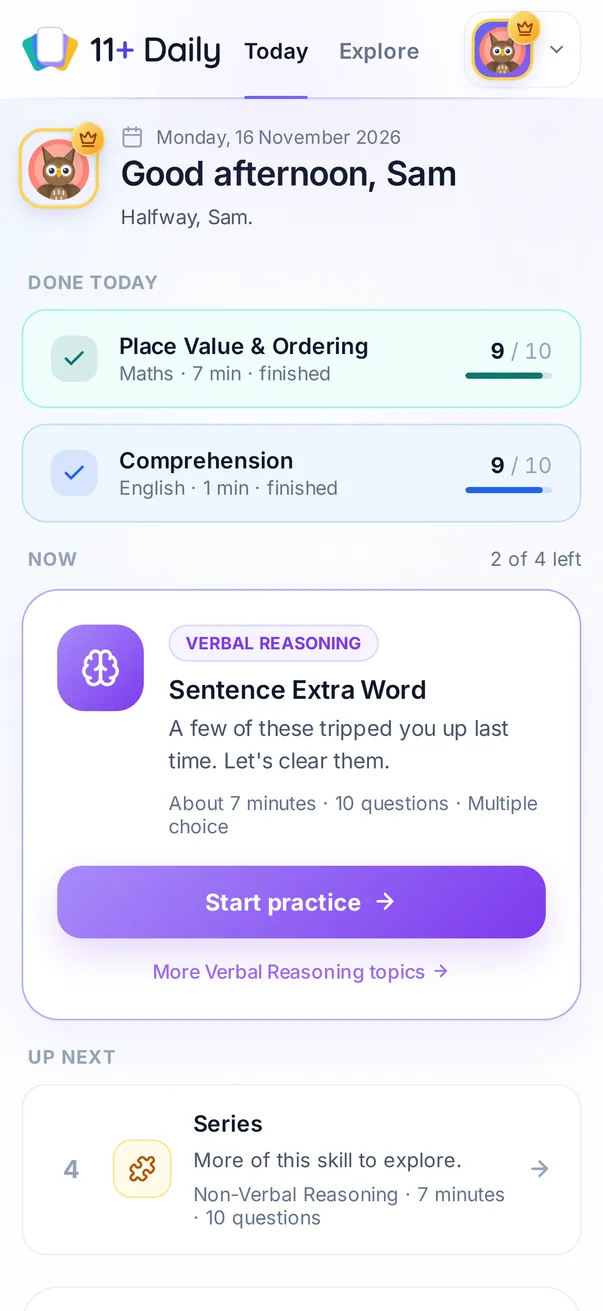
That pattern is what moves a result, in a score area or a ranking one, because the raw mark is the only part of the calculation your child controls, and in a ranking every extra mark moves a child past others on the list. Spotting the pattern by hand means marking every paper and keeping notes. 11+ Daily keeps them for you: the parents area shows accuracy by subject and by skill, so a gap like fractions shows up without marking anything. See how the Today screen picks each session.
The short version
Every 11 plus paper is marked, standardised for age and combined into a total. Some areas send that total as a score and measure it against a qualifying score or a yearly threshold. Others rank every applicant and tell you your child’s position. Either way, each school’s own criteria, from pupil premium to postcode, siblings and appeals, decide the order in which places are offered, and they differ from area to area. Read the policy of every school you name.
See which skills are holding the result back
The eleven plus result arrives once, after the test, and no practice paper can predict it. What you can know in the meantime is which skills are secure and which are not, because those are what the raw mark is made of.
11+ Daily shows you that as your child practises. The Today screen picks one subject and one skill for each short session, about seven to ten minutes, with more whenever your child wants it. Wrong answers come back in later sessions until they are right, and Weak Points gathers the questions your child keeps missing into one drill. The parents area shows days practised, skills covered and accuracy by subject and by skill, across over 10,000 questions in 79 skills. Start your free 14-day trial, with every subject unlocked and no card needed.
Try two questions from the app
One English and one Maths. Choose an answer and you will see what your child sees: whether it is right, and why.
Synonyms
What is the SYNONYM (same meaning) of:
THRIVE
Fractions of Amounts
Choose the correct answer.
A farmer has 60 eggs. He sells 3/5 of them at the market. How many eggs does he sell?
Last updated 31 October 2026.
Try 11+ Daily with your child.
11+ Daily shows you, skill by skill, where your child is secure and where they are not, so you are not guessing from a practice paper percentage.
14 days free, no card. Then £9.99 a month if you carry on.