How to prepare for the 11+ without a tutor
Plenty of families prepare for the 11 plus without a tutor, and plenty of families with one still do most of the work at home. Here is what a tutor actually provides, how much of it you can build yourself, and where a few paid sessions earn their money.
What a tutor actually provides
Ask parents why they hired an 11 plus tutor and the answers are rarely about secret knowledge. They are about process. Someone else decides what to work on this week. There is a fixed hour that happens whether or not everyone is tired. Somebody notices that fractions keep going wrong and explains them in a way the child understands. And there is an adult who is not a parent telling the child they are doing well.
Those are real benefits: structure, accountability, a view of weak areas and explanations on demand. What a tutor cannot honestly promise is a result; nobody can tell you in advance what difference an hour a week made. Prices vary a great deal by area, by one-to-one or small group, and by in person or online, so the useful figure is a local quote, not a national average.
Most of what a tutor supplies can be built at home, and the parts which cannot are narrower than they look. The material is not a mystery: Key Stage 2 English and Maths, plus, in many tests, Verbal and Non-Verbal Reasoning, all well documented. Our guides to the maths topics on 11+ papers, what the English paper tests and the verbal reasoning question types cover the ground.
Building the same things at home
Take each thing a tutor provides in turn. If the test itself is still a blur, what the 11 plus is and how it works is the place to start.
A fixed slot
The tutor’s hour works because it is fixed. You can fix a slot yourself, and a daily one beats a weekly one: fifteen to twenty-five minutes in the first half of Year 5, stepping up to twenty-five to thirty-five from around March for a September test, at the same time each day. Our guide to how much 11 plus practice a child needs each day has the numbers by stage. The failure at home is not doing too little on one night; it is the slot quietly disappearing in a busy week. Protect it like a paid appointment.
Something that decides what to do
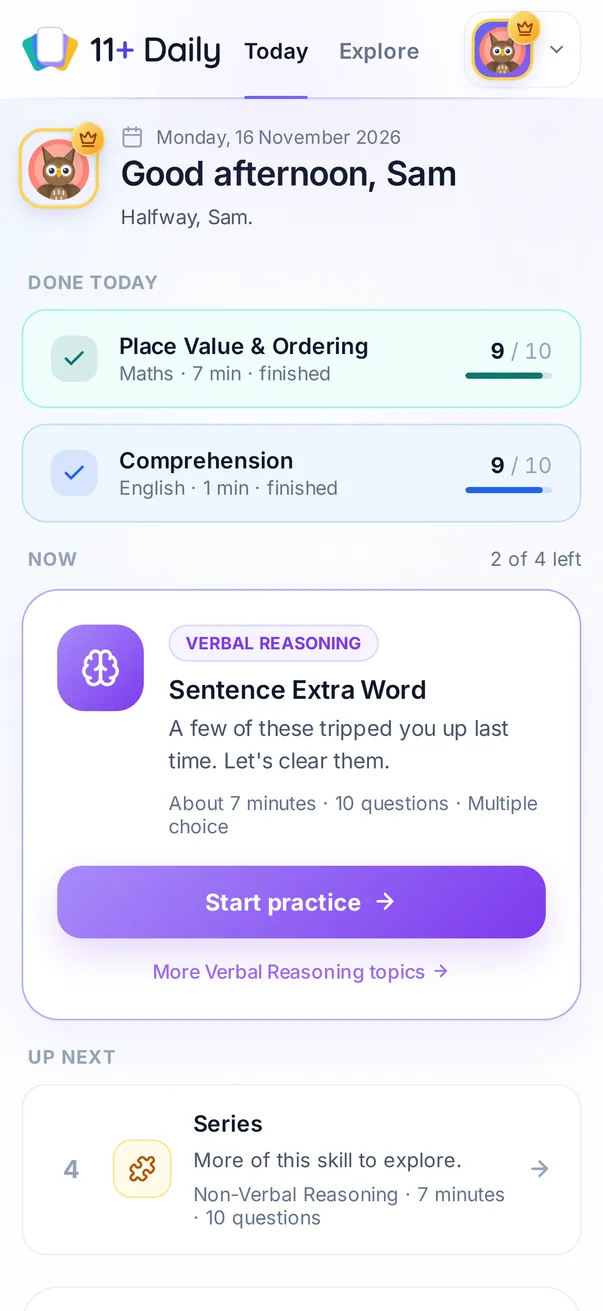
This is the part parents underestimate. A tutor arrives knowing what this week’s session is about. At home, “what shall we do tonight?” is where most evenings stall, and why a shelf of workbooks so often ends up half done. You need a structure that makes the decision: a rota across the subjects your child’s test covers, a workbook worked front to back, or an app whose job is to choose. In 11+ Daily that is the Today screen: it picks one subject and one skill for each session, from what is weak and what has not been practised lately, so the slot starts with a task (how the Today screen picks each session).
A way to see weak areas
A tutor notices patterns because they mark the work. You can do the same with a notebook: every wrong answer, dated, with the topic. After a few weeks it will say something specific, “fractions of amounts, reading timetables, antonyms”, and that is a plan. Revisit the wrong answers a few days later rather than on the spot, so the correction has to be recalled. A tool that records accuracy by skill does the same job without the notebook.
Occasional mock papers
Tutors run mocks; so can you. For a September test, one full paper a month from around March of Year 5, on a weekend morning, timed, then marked together, and most weekends in the final month. Looking at which questions went wrong tells you far more than the total. Our Year 5 plan, term by term sets out where the mocks fall, including for tests sat at the end of Year 5.
Someone to explain a stuck topic
This worries parents most, and it is more solvable than it feels. For most topics, a parent with the answer explanation in front of them is enough. Where it is not, a workbook’s worked examples or the class teacher asked at pick-up usually gets a child over the hump. Keep a short list of topics that will not click after two attempts; that list is what a few paid sessions are for, if you get there.
What a tutor adds that is hard to replace
Two things, honestly. The first is an outside adult. Some children work harder for a tutor than for a parent, and some parent-and-child pairs cannot practise together without an argument. In that house, an outside adult is what makes the practice happen at all.
The second is a second opinion on readiness. A tutor sees many children and can say with some grounding whether a weak area is normal for the age and whether the practice is pitched right. A mock score and a talk with the class teacher give you part of that.
When a few sessions are worth paying for
The choice is not “a tutor for a year or nothing”. A short block aimed at a specific problem often makes more sense than a weekly booking. Consider a few sessions when:
- A specific topic will not click after you have explained it twice.
- You want an outside opinion on how ready your child is, perhaps after a mock in the summer term.
- Practice at home has become a source of arguments.
- Your child has lost confidence and would benefit from someone who is not a parent telling them they are doing well.
In each case, arrive with the notebook or the accuracy record, so the sessions go straight to the problem.
Preparing for the 11 plus without a tutor: what a week looks like
A realistic week in the first half of Year 5 is not complicated. Five or six short sessions, each with a task already chosen. Reading every day. A note of what went wrong and a return to it later in the week. From the spring, one mock paper a month. The eleven plus rewards consistency far more than intensity, and consistency is something a family can supply.
The honest summary
A tutor sells process: a slot, a plan, a view of weak areas, explanations, and an outside adult. The first four can be built at home with a fixed time, a structure that decides, a record of wrong answers and a monthly mock. The fifth is harder to replace, and if practice is turning into a fight or one topic will not shift, a short block of sessions aimed at that problem is money well spent.
The plan and the notebook, kept for you
Without a tutor, the parent becomes the planner and the marker. 11+ Daily takes both jobs. The Today screen decides each session, one subject and one skill, from what is weak and what has not been touched lately, and shows your child the reason. Every answer is marked instantly; wrong answers come back in later sessions until they are right, and Weak Points gathers the ones your child keeps missing into one drill. The parents area shows days practised, skills covered and accuracy by subject and by skill: the notebook, kept for you. It is daily practice, not tutoring, and works alongside a tutor or without one. A session is about seven to ten minutes, with more there when your child wants it. Start your free 14-day trial, every subject unlocked, no card needed.
Try two questions from the app
One English and one Maths. Choose an answer and you will see what your child sees: whether it is right, and why.
Synonyms
What is the SYNONYM (same meaning) of:
THRIVE
Fractions of Amounts
Choose the correct answer.
A farmer has 60 eggs. He sells 3/5 of them at the market. How many eggs does he sell?
Last updated 25 October 2026.
Try 11+ Daily with your child.
11+ Daily does the planning a tutor would: the Today screen decides each session from what is weak and what has gone stale, and the parents area shows accuracy skill by skill.
14 days free, no card. Then £9.99 a month if you carry on.