Starting 11+ preparation in Year 4: how light is light enough?
Year 4 is early. Early enough that the most useful preparation does not look like exam preparation at all. Here is what is worth doing at eight or nine, what to leave well alone, and how to tell when light has become too much.
Why Year 4 is early for the 11 plus
In most grammar school areas the 11 plus is sat in September at the start of Year 6, so a child in Year 4 is roughly two years from the test. A few tests come earlier, such as the Gloucestershire FSCE test at the end of Year 5; confirm the current arrangements with your admissions authority. Either way, the child who sits the paper will be more fluent and far better at concentrating than the eight-year-old in front of you now, and much of what the test rewards will be taught at school in the meantime.
That is the case for going light. Heavy preparation in Year 4 banks little, because much of it will be re-taught, and it spends something hard to get back: a child’s willingness to sit down and do it. Our guide to how much 11 plus practice a child needs each day puts Year 4 at ten to fifteen minutes, four or five days a week, and that is a ceiling.
So the question is not whether to do anything. Reading, vocabulary and arithmetic all pay off, and none of them needs to feel like exam work. If you are still working out the test itself, what the 11 plus is covers who sits it, what is in it and how it is marked.
What is worth doing in Year 4
Reading, every day
Reading is the single most useful thing a Year 4 child can do for the eleven plus, and it does not look like preparation at all. Comprehension, vocabulary, spelling and a feel for how sentences work all come from it. Anything they will actually read counts: novels, comics, non-fiction about whatever they are into. Twenty minutes a day, and talk about it now and then.
Vocabulary, a little at a time
English, and Verbal Reasoning where it is tested, lean on word knowledge, and vocabulary grows slowly, so starting early is one of the few things that genuinely compounds. Keep it small: a word or two a day, met in a sentence, and brought back a few days later. Words from their own reading stick better than words from a list.
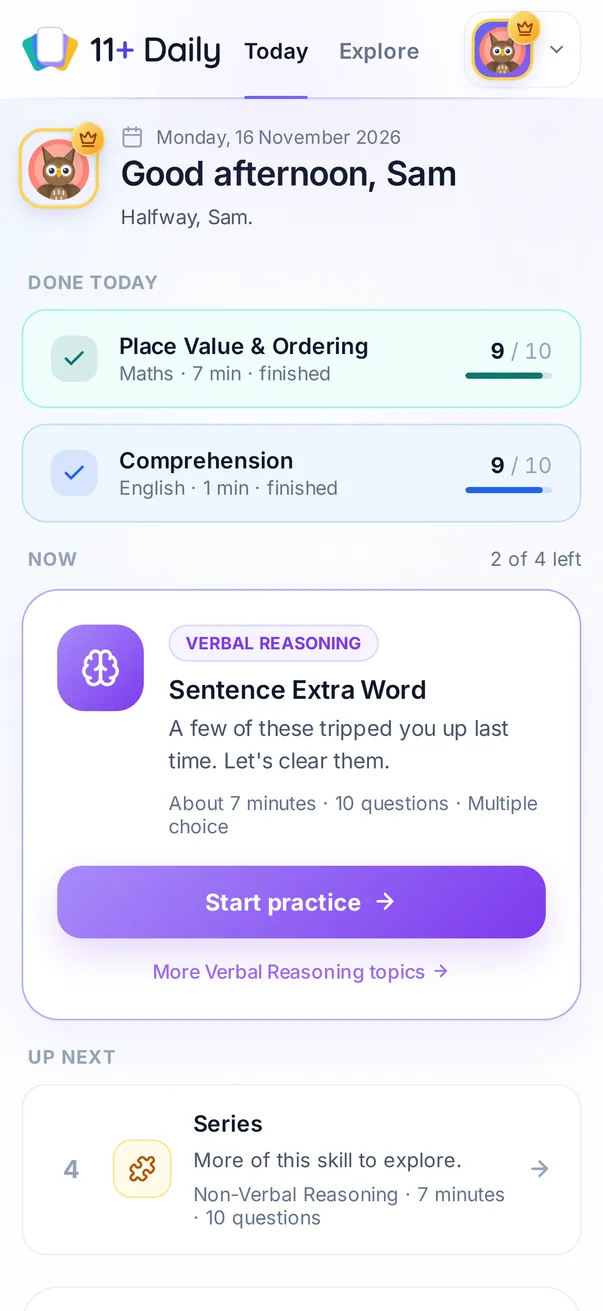
Bringing each word back at the right moment is the fiddly part. 11+ Daily’s word cards do it with spaced repetition: a word answered correctly returns at growing intervals (how the Today screen picks each session).
Times tables and mental arithmetic
Fluent tables and quick mental arithmetic underpin most of the maths on an 11+ paper, and Year 4 is when school expects tables to be secure anyway. Five minutes of tables in the car, or “what is seven eights, and what is half of that” over tea, is worth more than a page of sums. If tables are secure, move on to adding and subtracting in the head, doubling and halving, and simple fractions of amounts.
Gentle exposure to the formats
The one piece of exam-shaped work that earns its place in Year 4 is familiarity. A few verbal reasoning puzzles now and then, if your child’s test has them, so “find the hidden word” is not a strange instruction the first time it matters. A handful of multiple-choice questions, so choosing from a set of options feels normal. A couple of non-verbal reasoning puzzles, which many children enjoy because they feel like games. Our guides to the verbal reasoning question types and the non-verbal reasoning question types show what the formats look like. The aim is that nothing is a shock in Year 5.
What not to do in Year 4
- Mock papers. A full paper at eight measures what has not been taught yet. The score is meaningless and the experience can be frightening.
- Timed tests of any kind. The clock is a Year 5 skill, and a late one.
- Tutoring several times a week. A child tutored three times a week in Year 4 has nowhere to go in Year 5, and is likely to be tired of it by the time it counts.
- Long sessions. If practice regularly runs past fifteen minutes, it is too much for the age.
- Anything that makes a nine-year-old dread it. The moment 11+ work becomes something to argue about, go lighter.
A suggested week of 11 plus preparation in Year 4
Four or five days, ten to fifteen minutes each, most of it reading and vocabulary:
| Day | Ten to fifteen minutes |
|---|---|
| Monday | Reading, and one or two new words from the book |
| Tuesday | Times tables or mental arithmetic, then reading |
| Wednesday | A few reasoning puzzles, or a few maths questions if the test has no reasoning |
| Thursday | Reading, and a return to the words from earlier in the week |
| Saturday | A handful of maths questions in multiple-choice format, then reading |
Reading can happen every day on top of this. Nothing is timed, nothing gets a score, and a missed day is just missed. The point is to make a small habit ordinary, not to cover ground.
Warning signs you are doing too much
- Your child resists practice they were happy to do a month ago.
- They rush through to get it over with.
- Tears before or during a session.
- They start to describe themselves as “bad at maths” or “bad at words”.
- You are doing it because other parents are, not because your child needs it.
Any of these in Year 4 means scale back, and it is fine to stop for a few weeks. A child with a good relationship with practice at the start of Year 5 is worth far more than one who is a term ahead and fed up.
When to step up
For a test in September of Year 6, the start of Year 5 is when daily practice becomes a real habit: fifteen to twenty-five minutes a day, five or six days a week, across every subject the test covers. That is the moment for structure, for tracking weak areas and, later, for mock papers. Our Year 5 plan, term by term lays out the year from there.
Where the test is sat at the end of Year 5, the step-up comes a little earlier, because there is no summer holiday before it. The Gloucestershire FSCE test is the main example: it is sat in July at the end of Year 5, with English and Maths and no Verbal or Non-Verbal Reasoning, so a Year 4 child there can start the Year 5 habit from the summer term of Year 4. Our post on the Gloucestershire move to FSCE has the detail, and the schools have the current arrangements.
The honest summary
Light enough is lighter than most parents expect. Ten to fifteen minutes, four or five days a week, most of it reading and vocabulary, with a few puzzles so the formats are familiar. No mocks, no clock, no dread. Step up at the start of Year 5, or a term earlier for a test at the end of Year 5.
Small daily doses, already chosen
The risk in Year 4 is a parent choosing too much, or nothing at all. 11+ Daily makes the choice small and specific. The Today screen picks one subject and one skill, and a session is about seven to ten minutes, so a child meets the formats a little at a time without you setting the questions; more is there on a day they want it. Questions are pitched at the 11+, so in Year 4 a session a few days a week is plenty. Vocabulary word cards come with British audio and return at growing intervals, and the parents area shows days practised and skills covered, so you can see it staying light. It works in the browser on a laptop, tablet or phone. Start your free 14-day trial, every subject unlocked, no card needed.
Try two questions from the app
One English and one Maths. Choose an answer and you will see what your child sees: whether it is right, and why.
Synonyms
What is the SYNONYM (same meaning) of:
THRIVE
Fractions of Amounts
Choose the correct answer.
A farmer has 60 eggs. He sells 3/5 of them at the market. How many eggs does he sell?
Last updated 25 October 2026.
Try 11+ Daily with your child.
11+ Daily keeps Year 4 light without you choosing the questions: one short session on one skill, picked by the Today screen, with vocabulary that comes back at growing intervals.
14 days free, no card. Then £9.99 a month if you carry on.