11+ access arrangements: extra time, rest breaks and other adjustments
If your child has special educational needs, a disability or a difficulty that affects how they work, the 11 plus can usually be adjusted for them. The adjustment has to be asked for, usually by the school, before a deadline that falls well before the test. Here is how it generally works, and what to ask.
What 11 plus access arrangements are
Access arrangements are changes to how the 11 plus is sat, so that a child with special educational needs, a disability or another difficulty can show what they know. Extra time and rest breaks are the ones parents hear about most, but they are not the only ones. Different areas call them access arrangements, special arrangements or adjustments; they mean the same thing.
The purpose is access, not advantage. Admissions authorities are generally clear that an arrangement should remove a barrier, not give a child a head start over others. That is why so much of the process turns on how your child already works at school.
This post covers the general picture, which is broadly the same across areas. The details, including forms, evidence and deadlines, belong to the admissions authority that runs your child’s test, so confirm the current arrangements with the admissions authority before relying on anything here. If you are not sure who that is, our guide to which 11 plus your area uses explains how to find out.
Who asks, and when
In most areas, the request comes from your child’s current school rather than from you. The headteacher or the special educational needs coordinator (SENCO) fills in a form from the admissions authority and sends it with whatever evidence it asks for. Your part is to register your child for the test in the normal way and to tell the school, early, that you think adjustments may be needed.
Registering and requesting are usually separate steps. Registering does not, on its own, ask for any adjustment, and a request does not register your child. Do both.
The deadline normally falls around the time registration closes, which for a September test is often in the early summer of Year 5. Some authorities say plainly that a late request will not be accepted. If your child’s school has a SENCO, a short conversation in the spring term of Year 5 is a sensible time to start. Our list of 11 plus registration and test dates for 2027 shows the windows each area has published.
If your child is sitting more than one test, perhaps a grammar school test and an independent school’s own paper, each one runs its own process. An arrangement agreed for one test does not carry over to another.
The evidence a request usually needs
Most authorities want to see that the adjustment matches a real, established need, and that it is already part of how your child works. The evidence usually comes from school: what support is in place, how often it is used, and why. Where a child has a report from a specialist, it may be included too; ask whether your admissions authority wants one.
A diagnosis is not always required, and a label alone is not always enough. What matters is the picture of how your child works day to day. If your child is waiting for an assessment, ask the admissions authority what to do rather than waiting: at least one authority says a request should not be held back for that reason.
Typical adjustments
The list varies by area, but these come up most often:
- Extra time, often a set percentage on top of the standard time.
- Rest breaks, short pauses during a paper.
- Enlarged or modified papers, such as a larger-size paper.
- A separate room, or sitting with a smaller group, for a child who would be distracted, or would distract others.
- Extra aids or support, such as a reading pen, an adult to help a child stay on task, or a reader, where the admissions authority allows it.
Not every authority offers every adjustment. Ask for the full list your admissions authority publishes, rather than assuming.
Arrangements follow how your child normally works
This is the principle that runs through every admissions page we have read: an arrangement should reflect your child’s “normal way of working”. If your child has rest breaks in class, a request for rest breaks has evidence behind it. If they have never used extra time at school, a request for extra time on test day is harder to support, and may not help much either, because they have not learned to use it.
So the most useful conversation is with your child’s class teacher and SENCO, well before the deadline. Ask what support your child actually receives, whether it is written down, and whether the school would describe it as their normal way of working.
What two admissions authorities say
To show how this plays out, here is what two admissions authorities published at the time of writing (October 2026). Both pages cover their own test only, and both change from year to year, so confirm the current arrangements with the admissions authority.
Buckinghamshire. Buckinghamshire Council’s page on access arrangements for the Secondary Transfer Test says the arrangements “must not advantage the child” and “should also be based on what normally happens in class at school”. It groups adjustments into three types: changes to how the test is run (short breaks, extra time), changes to a physical feature (a larger-size paper), and extra aids or services (reading pens or readers). For children at a Buckinghamshire primary or Partner school, the headteacher applies. Requests are reviewed by panels that include an educational psychologist.
Medway. Medway Council’s Medway Test page says the child’s current school must submit a special arrangements request form, and gave a school deadline of Monday 22 June 2026 for that round. It says a child with an EHCP will be granted 25% additional time where the school deems this appropriate, and that other arrangements need evidence for a panel. It also says special arrangements “are not transferable between different local authorities and selection tests”.
Two areas, two slightly different processes, the same principles: the school applies, the deadline is early, the evidence is about class practice, and the authority decides.
The decision is the admissions authority’s
Requests are usually decided by a panel at the admissions authority, not by the school. The decision may be all of what was asked for, part of it, or something different. If you disagree, ask the admissions authority what route, if any, exists, and do it promptly.
Practising at home with access arrangements
Whatever is agreed, it helps if nothing about the format is new on the day. Our guide to what to expect on GL 11 plus test day covers the answer sheet and the clock, and if your child’s test uses a different format, the admissions authority’s own familiarisation material is the place to start.
If your child has extra time, practise with it. Time a mock paper at their allowance, not the standard time, so they learn how the extra minutes feel and how to use them: checking, going back to a question they skipped, filling every box. Equally, practise with rest breaks if they have them, so a pause in the middle of a paper feels normal rather than unsettling. If you are not yet sure what will be agreed, practise at the standard time first, and add the allowance once you know.
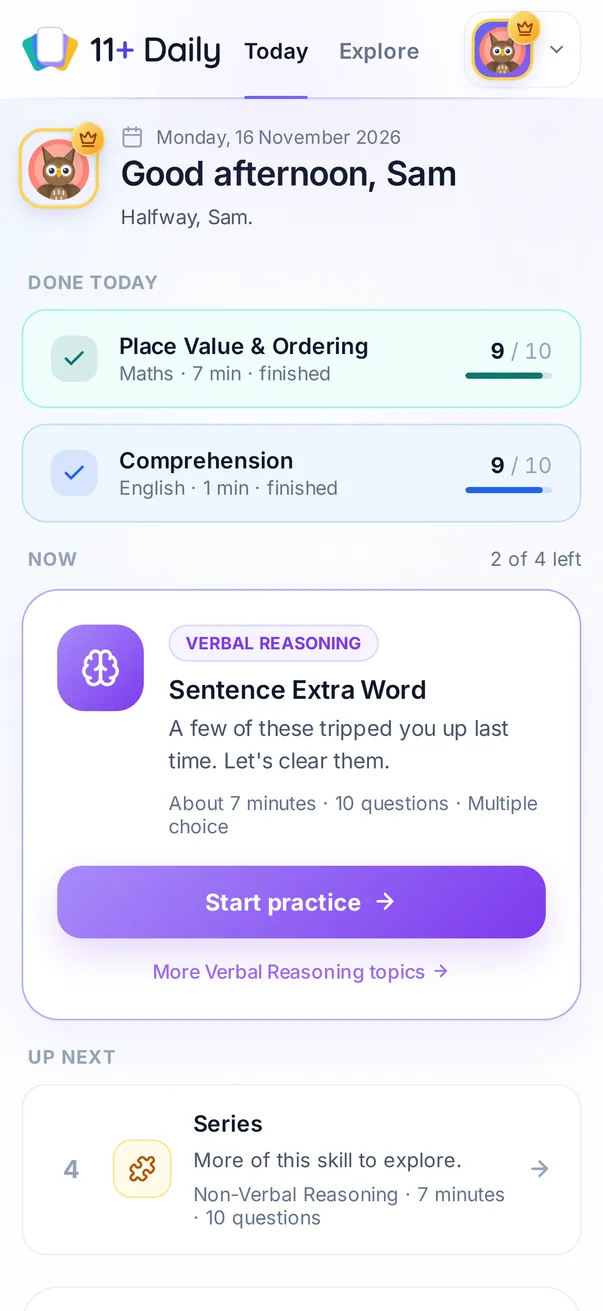
Keep daily practice ordinary. Short, regular sessions build the skills underneath the eleven plus, and those do not change with the arrangements. Choosing what to practise each day, at a pace that suits your child, is the part 11+ Daily does: the Today screen picks each session from what is weak, one skill at a time.
The short version
Talk to your child’s school early, in the spring of Year 5 if you can. Register for the test, and make sure the school sends its request before the deadline. Base the request on how your child actually works in class, practise with whatever is agreed, and confirm the current arrangements with the admissions authority for every test your child sits.
Steady daily practice, whatever is agreed
Access arrangements change how the test is sat. The skills underneath it are built the same way for every child: a little practice, most days, on the right thing.
11+ Daily plans that for you. Each session is one subject and one skill, chosen by the Today screen from what your child finds hard and what they have not practised for a while, so they use one method at a time rather than switching between question types. A session takes about seven to ten minutes, with more there whenever they want it. Wrong answers come back until they are right, and the parents area shows accuracy by subject and by skill, so you can see progress without asking your child. Start your free 14-day trial, with every subject unlocked and no card needed.
Try two questions from the app
One English and one Maths. Choose an answer and you will see what your child sees: whether it is right, and why.
Synonyms
What is the SYNONYM (same meaning) of:
THRIVE
Fractions of Amounts
Choose the correct answer.
A farmer has 60 eggs. He sells 3/5 of them at the market. How many eggs does he sell?
Last updated 18 November 2026.
Try 11+ Daily with your child.
11+ Daily gives your child short, calm daily practice that adapts to them: each session is one subject and one skill, chosen from what they find hard, with wrong answers brought back until they are right.
14 days free, no card. Then £9.99 a month if you carry on.