GL 11+ vocabulary: how much it matters, and how to build it
Question formats can be learned in weeks. Vocabulary cannot, and that is worth knowing in Year 4 rather than in the summer before the test.
The three places a word is worth a mark
Vocabulary is the largest hidden variable in the 11 plus, and on a GL paper it is marked in three separate places rather than one.
It is marked in Verbal Reasoning, where several recurring families are word-meaning questions in a puzzle wrapper. It is marked in English, where comprehension questions ask directly what a word means as it is used in the passage. And it is marked a third time, invisibly, in reading comprehension: a word the child does not know inside a passage does not only cost that sentence, it costs the inference question built on it two questions later.
That third one is why vocabulary is worth more than its share of the marks. Not every area sets Verbal Reasoning, but every area tests reading. For how the subjects fit together, see what the 11 plus is. A child who has learned every question family will still read a closest-meaning question perfectly, understand exactly what is being asked, and not know which word it is. Why the GL 11 plus is learnable sets out that split: familiarity removes the surprise, knowledge decides the mark. The families themselves are listed in the GL 11 plus question type checklist, and what the GL English paper contains covers the comprehension half in full.
None of this is particular to one board. Word meaning carries weight whoever sets the paper, and the areas moving to Quest or FSCE for 2028 entry are not moving away from it. Confirm the current arrangements with the admissions authority; our guide to the GL Assessment 11 plus lists who is moving and when.
Why it is the part that cannot be crammed
Almost everything else in eleven plus preparation responds to effort in the short term. A question format can be learned in an evening, a maths topic taught in a week, tables drilled in a term.
Vocabulary does not. Word knowledge is the residue of a very large number of encounters with words in context, most of them from reading and most of them not noticed at the time. What a Year 6 child has is largely a function of how much they have read since Year 2, and no programme started in the spring changes that total by much.
So if you are reading this in Year 4, the main action is more reading. If you are reading it in the summer before the test, the honest position is that the vocabulary your child has is roughly the vocabulary they will have. Short daily work still helps then, because it can secure words they have met and half remember. It cannot manufacture words they have never seen.
What the questions actually look like
Three worked examples.
A word whose meaning the sentence decides
“The driver was rude and abrupt when answering the passenger’s polite question about the route.”
Which word could replace abrupt? lengthy, curt, polite, sudden, lively
Read the sentence first and the word second. Abrupt has two everyday senses: happening suddenly, and short to the point of rudeness. Here it sits beside rude and describes how someone answered a question, so the answer is curt.
The tempting wrong answer is sudden, for the most instructive reason on this page: it is a correct meaning of the word. A child who met abrupt once on a list, glossed as “sudden”, recognises the word, picks the meaning they were taught, and is not guessing. They lose the mark because they know the word thinly rather than because they do not know it.
Two bracketed sets, one pair
Verbal Reasoning packages word meaning differently. Two sets of words are shown in brackets, and the child finds one word from each set closest in meaning to each other. A matching family asks for the pair most opposite in meaning.
(cold sweet long) (sour bright chilly)
Take the first set one word at a time and ask whether anything in the second set means the same thing. Cold and chilly both describe a low temperature, so the answer is cold and chilly.
The trap is sweet and sour. They are a familiar pairing, one in each set, and a child working at speed lands on them because they are obviously related. They are opposites, which is what the other family asks for. The fix here is a routine, not more vocabulary: name the type before starting.
A word you half know
ANCIENT
Old, Historic, Modern, Timeless, Traditional
Decide the core meaning first, then look for its reverse rather than a word on the same theme. Ancient means very old, so the answer is Modern.
Old, Historic and Traditional all point backwards in time, as ancient does, so a child scanning for connected words finds too many. Timeless is the subtler trap: something that never seems to date is not the opposite of old. Knowing roughly what a word is about is not enough when every option is roughly about the same thing.
The word-meaning families, from what they ask
Skill names mislead, so here is what each vocabulary skill in 11+ Daily puts in front of a child.
| Skill | What the child is asked |
|---|---|
| Vocab in Context | A whole sentence with one word singled out. Most ask which word is closest in meaning to it, some which word could replace it in that exact sentence, and the rest what the word suggests about someone. |
| Synonyms | One word, five options, choose the closest in meaning. The wrong options often include its opposite. |
| Antonyms | One word, five options, choose the opposite. The wrong options are usually near-synonyms of the word itself. |
| Pick the Meaning | One word and five definitions written out in full. One is right; the others are plausible meanings of other words. |
| Word Cards | One word at a time, nothing to choose from. Say what it means from memory, then turn the card for the meaning, an example sentence, three near-synonyms and three near-opposites, and mark yourself. |
| Idioms and Phrase Meaning | A sentence containing an everyday saying, and the question asks what the phrase means. |
| Figurative Language | Name the technique at work in a line of writing: simile, metaphor, personification, alliteration, onomatopoeia or exaggeration. Some ask instead which image a longer sentence uses, or which of five sentences contains a given technique. |
| Closest Meaning, Opposite Meaning | Verbal Reasoning. Two bracketed sets of words; find the one word from each set closest in meaning, or most opposite in meaning, to each other. |
Two of those are easily confused. Figurative Language asks the child to name the device, so the answer is a word like simile. Idioms and Phrase Meaning asks for the meaning, so the answer is a paraphrase. Our guide to the GL Verbal Reasoning question types covers the reasoning families.
What a word list is good for, and what it is not
They work for revision. A child who has met three hundred words and retained two hundred has a real problem a list solves neatly. Covering the meanings, saying each aloud and marking the ones that failed is an efficient ten minutes.
They work badly as a first meeting. A word learned only as a one-line gloss often does not survive contact with a new sentence, which is what the abrupt example shows. The list gives one meaning; the paper gives the word in a sentence chosen to test whether the child can tell which sense is meant.
We do not publish a word list here. The live papers are confidential, so any list is somebody’s inference about which words appear. Build instead from the words your own child meets and does not know.
How to practise 11 plus vocabulary at home
Five things, in rough order of how much they matter.
- Volume of reading, measured in years. This is most of the answer. Twenty minutes a day from Year 3 is a different quantity of text from twenty minutes a day from Year 5.
- Breadth over re-reading favourites. A series read eight times supplies one author’s vocabulary eight times. Rotate a novel, a newspaper article, a non-fiction book about something they like, and something written before they were born.
- Words met in context, then collected. Keep a running list of words your child met in their own reading and could not explain. Every word on it is already attached to a sentence they remember.
- Talking about what was read. “What does reluctantly tell you there?” Five minutes of that most days does more than a worksheet, and costs nothing.
- Spaced recall, for words met but not retained. Revisit a new word a few days later and again a week after that. Keeping track of which words are due is the fiddly part, and it is what 11+ Daily’s Word Cards do: a word answered correctly comes back at growing intervals, so the gaps are planned for you.
Two things to avoid. Do not do a hundred words in one sitting; almost none of it lasts. And do not let vocabulary crowd out the reading, because the reading is what produces the words. How 11 plus comprehension and writing are built at home sets out the weekly routine the vocabulary work sits inside.
Words that come back until they stick
The reading supplies the words. What slips is the second and third meeting with each one, because nobody can track which of a few hundred words is due today.
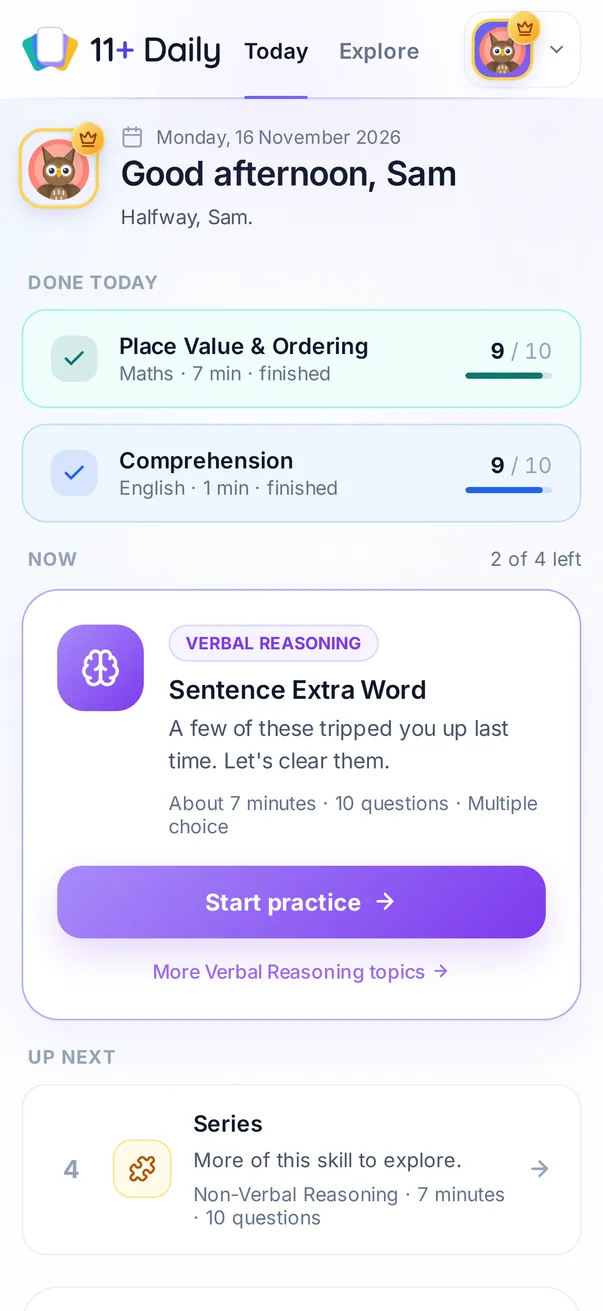
11+ Daily does that tracking. Word Cards, with British audio, bring each word back at growing intervals, and the multiple-choice vocabulary skills in the table above bring a missed question back in a later session until it is right. The Today screen picks one subject and one skill each day, so vocabulary comes round alongside spelling, grammar, Maths and, where your test has it, Verbal Reasoning, without a parent planning it. A session takes about seven to ten minutes, with more whenever your child wants it, and the parents area shows accuracy skill by skill. Start your free 14-day trial, every subject unlocked and no card needed.
Try two questions from the app
One English and one Maths. Choose an answer and you will see what your child sees: whether it is right, and why.
Synonyms
What is the SYNONYM (same meaning) of:
THRIVE
Fractions of Amounts
Choose the correct answer.
A farmer has 60 eggs. He sells 3/5 of them at the market. How many eggs does he sell?
Last updated 25 October 2026.
Try 11+ Daily with your child.
11+ Daily keeps your child's 11 plus vocabulary coming back until it sticks: word cards on growing intervals, plus synonyms, antonyms, words in context, idioms and figurative language.
14 days free, no card. Then £9.99 a month if you carry on.