Why the GL 11+ is learnable, and what that means for practice
A test built from recurring formats rewards a different kind of preparation from a test designed to be unpredictable. The GL 11 plus is the first kind, and most families practise it as though it were the second.
What a format-based test is
Exam boards make a choice when they design an 11 plus test. They can build it from recognisable question types that appear every year, or they can deliberately vary the shape so that rehearsal is worth less.
GL Assessment papers are the first kind. They are built from established question families that recur year after year, and a child who has seen a format before reads the instructions once and gets on with it. The old CEM tests were closer to the second kind, with mixed papers, short sections and an order that could change. CEM stopped setting 11 plus tests in 2023.
That is a description, not a criticism, and it has a practical consequence most families miss. A format-based test rewards a different order of preparation from an unpredictable one, and the 11 plus advice a parent finds first was mostly written for neither. For the test as a whole, see what the 11 plus is.
Why the formats recur
Three things hold GL papers stable, and it is worth knowing them rather than taking the claim on trust.
The scores are standardised. A standardised score is only fair across years if the papers are built the same way each year, so a board has every reason to keep its formats steady. Live papers are confidential and never published.
The formats are published in advance. GL produces free familiarisation material so that children meet the kinds of question and the answer sheet before the day, and many admissions authorities link to it. GL’s own parent guide notes that the questions may not be exactly the types on the real test, but the families are recognisably the same.
And the subject families are not arbitrary. Closest meaning, opposite meaning, letter series, word-number codes: these are long-established verbal reasoning types with decades of use behind them. They are not a GL invention and they are not going to be replaced by something nobody has seen.
What learnable does not mean
This is where a lot of eleven plus preparation goes wrong, so it is worth being blunt about the limits.
It does not mean the paper is predictable. The formats recur. The content does not. Nobody outside GL and your admissions authority has seen this year’s paper, and a resource that claims to know what is on it is guessing. Knowing the families means your child recognises the question, not that they have met it.
It does not mean format practice replaces knowledge. GL Verbal Reasoning is heavily dependent on vocabulary, and the Maths paper is the Key Stage 2 curriculum. A child who knows every question family but has a thin vocabulary will read the closest-meaning question perfectly, understand exactly what is being asked, and still not know which word it is. Familiarity removes the surprise. Knowledge decides the mark.
And it does not apply evenly across the four subjects. That is the part almost nobody says out loud, so here it is in full.
| Subject | How format-driven | What actually moves the mark |
|---|---|---|
| Verbal Reasoning | Very | Learning each family, then vocabulary |
| Non-Verbal Reasoning | Very | Learning each family, then careful looking |
| Maths | Partly | The Key Stage 2 curriculum, taught properly |
| English: spelling and punctuation | Very | The error-spotting routine |
| English: reading comprehension | Hardly at all | Reading widely, over years, and vocabulary |
The bottom row is the honest one. A comprehension passage is new every time, and the questions turn on inference, vocabulary in context and what the writer was doing. There is no routine that substitutes for having read a lot of books.
The order this implies
If the formats are stable and the knowledge is what decides the mark, the sequence follows almost mechanically.
- One family at a time, to accuracy, with no clock. The child should be able to name the type in front of them and say what the routine is before they start. Speed at this stage is worth nothing, and chasing it teaches guessing.
- Then mixed practice, still untimed. The skill being built here is different: recognising which type you are looking at when nothing tells you. That is a real skill and it is invisible while every worksheet is labelled.
- Then timing, one type at a time. Pace is a separate thing from accuracy and should be built on top of it, not alongside it.
- Then full papers, and fewer than you think. From around the spring of Year 5, roughly monthly, more often in the last few weeks. A paper measures; it does not teach. Our guide to mock exams, when and how many goes into the numbers.
- Underneath all of it, vocabulary and tables, continuously. These take months and they are the floor everything else stands on. They cannot be started in the summer of Year 6.
Most families do this list backwards. They start with papers, because papers feel like the real thing. A paper sat in September of Year 5 mostly produces a low mark, a demoralised child and no information you could act on, because nothing has been learned yet for it to measure.
Steps 1 and 5 are the ones that need daily attention, and they are what 11+ Daily runs: each session stays on one skill, chosen by the Today screen, and vocabulary words return at growing intervals. See how the Today screen picks each session.
Where the answer sheet fits
One practical point that belongs to the format rather than the subject. In most GL areas the papers are multiple choice, with the questions in a booklet and the answers marked on a separate sheet that is read by machine.
That sheet is its own small skill. Marking the wrong row, skipping a question in the booklet but not on the sheet, or rubbing out badly are all easy to do under time, and they cost marks that have nothing to do with whether the child knew the answer. GL’s own parent guide to its familiarisation papers gives one mark for each correct answer and takes nothing away for a wrong one, so a box should never be left blank. A guess between the remaining options beats nothing. Practise the physical routine a few times before the day. Confirm the format with your admissions authority, because a few areas use GL’s standard-format papers instead, where the child writes the answer.
If your area is changing provider
Some of this transfers and some of it does not, so check which applies to you before committing a year to it.
Several areas have appointed a different provider for 2028 entry. Trafford and the seven Gloucestershire grammar schools move to FSCE; the Slough consortium, the Dorset and BCP consortium, The Latymer School and Bishop Wordsworth’s move to Quest. Bexley and the Wirral have already moved. The Gloucestershire FSCE test is sat at the end of Year 5 and has no Verbal or Non-Verbal Reasoning, and Trafford’s test moves to the summer term of Year 5 from 2029 entry.
If that is your area, the reasoning-format argument on this page matters less and the curriculum work matters more. The vocabulary and the maths still count either way. Our guide to the GL Assessment 11 plus has the full list of who is moving and when, and the 11 plus exam papers guide covers what material is worth using in the meantime.
How to practise for the GL 11 plus without a plan of your own
The order above is simple to describe and hard to run, because it means knowing which question families your child has met, which are secure and which have gone stale. 11+ Daily runs that order for you. The Today screen picks one subject and one skill for each session, from what is weak and what has not been practised for a while, so one family at a time happens without a plan of your own. A question answered wrongly comes back until it is right. The Verbal and Non-Verbal Reasoning follow the GL question types; the Maths covers the Key Stage 2 topics 11 plus papers test; the English covers vocabulary, spelling, grammar and comprehension passages. The parents area shows skills covered and accuracy by skill. A session is about seven to ten minutes, with more there when your child wants it. Start your free 14-day trial, every subject unlocked and no card needed.
Try two questions from the app
One English and one Maths. Choose an answer and you will see what your child sees: whether it is right, and why.
Synonyms
What is the SYNONYM (same meaning) of:
THRIVE
Fractions of Amounts
Choose the correct answer.
A farmer has 60 eggs. He sells 3/5 of them at the market. How many eggs does he sell?
Last updated 25 October 2026.
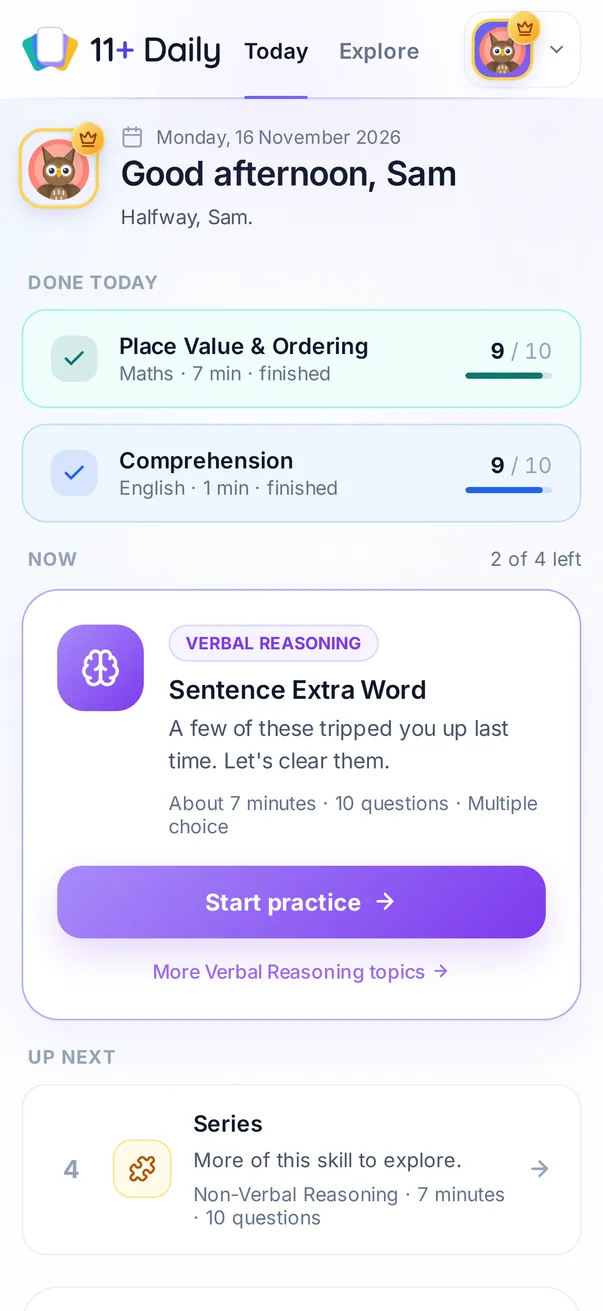
Try 11+ Daily with your child.
11+ Daily runs the practice order this post describes for you: one question family per session, chosen from what is weak or not yet practised, with wrong answers coming back until they are right.
14 days free, no card. Then £9.99 a month if you carry on.