GL 11+ English: the comprehension paper, and the skills underneath it
Most English practice material treats the paper as one subject. It behaves like two, and each half needs a different kind of work and a different start date.
What a GL English paper actually contains
An 11 plus English paper set by GL Assessment is mostly one thing: a passage of a few hundred words with questions on it. Usually fiction, sometimes non-fiction or a poem. Around that comprehension sits a technical section on spelling, punctuation and grammar, tested question by question.
That balance decides how a preparation year should be spent. Our guide to the GL Assessment 11 plus and its four papers covers the answer sheet, standardised scoring and which areas are changing provider. This page is about English alone, and what the 11 plus is covers the test as a whole. Which subjects your area tests, and how they are weighted, is a local decision, so confirm the current arrangements with the admissions authority.
The questions on the passage fall into four recurring kinds, and they ask for quite different things. Retrieval questions have their answer stated somewhere in the text, and the only skill is going back for it. Vocabulary in context asks what a particular word means in that sentence, which is often not its most common meaning. Inference asks why someone acted as they did, or what a detail implies, and the answer is never written down but always has to be supported by something that is. Writer’s-choice questions ask how the passage was built: why that word, why that image, what effect it has. Our page of worked comprehension questions takes a passage through all four.
The technical section is a different animal. Spelling, punctuation and grammar, in short discrete questions. One format papers use often takes a sentence, splits it into four labelled parts, and asks which part contains the mistake. Some sentences are correct throughout, and there is usually a fifth choice for saying so. Other technical questions ask which word completes a sentence correctly, or which word in a sentence is the subject, the object or the conjunction.
One half is learnable. The other is not, and nobody says so
The technical half behaves like Verbal Reasoning. The mistakes tested are a finite, repeating set: apostrophes for possession and contraction, homophones such as their, there and they’re, missing speech marks, a verb that does not agree with its subject, a comma doing a full stop’s job. There is a routine for finding them, the routine works, and a few months of proper practice on it changes what a child can do. Our post on why the GL 11 plus is learnable makes the same case for the reasoning papers.
The comprehension half does not work that way. The passage is new every time. A child who has done two hundred practice comprehensions has not seen the one in front of them, and the inference questions turn on having understood a piece of writing they have never read, at a reading speed that leaves time to think. No technique delivers that. It comes from having read a great deal, over years, and from having a vocabulary wide enough that the passage is not doing damage to them while they answer.
The practical consequence is the useful bit. The technical half can be left until the year before the test. The comprehension half cannot be started then. Families routinely do this the wrong way round, working hard on mistake-spotting worksheets in Year 5 because they are easy to mark, while the reading that would have mattered more was needed from Year 3.
Two worked examples from the technical half
Punctuation, in the chunked format. The sentence arrives split into parts:
A. Mum had / B. borrowed my class / C. teachers old map to help / D. plan the family’s route.
The method: read each part on its own and ask what punctuation it needs, rather than reading the sentence for sense. Sense is exactly what hides the mistake, because the sentence sounds fine aloud. Here the answer is the part containing “teachers”, which needs an apostrophe: the map belongs to my class teacher, so it is my class teacher’s map.
The tempting wrong answer is the final part, because it is the only part with an apostrophe already in it, and a child who has been taught to hunt for apostrophes finds one there and stops. “The family’s route” is correct: one family, one apostrophe before the s. The habit worth building is checking every part before choosing any of them, including the ones that look innocent.
Vocabulary in context. A sentence with one word singled out:
“The king decided to banish the dishonest minister from the kingdom for the rest of his life.”
Which word is closest in meaning to banish? welcome, promote, punish, praise, exile
The method: decide what the word itself means, then check that meaning against the sentence. The answer is exile, which is precisely what banish means, to send someone away from a place.
The tempting wrong answer is punish, and it is tempting for an instructive reason. The sentence is about a dishonest minister being dealt with, so a child reading the situation rather than the word picks the theme of the sentence. Banishing is a punishment, but punish does not mean banish: it covers a hundred things that are not sending someone away. Vocabulary-in-context questions are built to catch exactly this, a word the child half knows plus a distractor drawn from the surrounding story, and they are the closest thing in short daily practice to the vocabulary questions inside a comprehension.
What actually builds comprehension
Reading volume, measured in years rather than weeks. Twenty minutes a day from Year 3 is a different quantity of text from twenty minutes a day from the spring of Year 5, and the difference shows up in reading speed more than anywhere else. A child who reads slowly is not given more time in the exam; they are given less time to think.
Breadth, not a favourite series read eight times. The passage will not be a book your child has read, and it may well be older than they are, written in a register nobody uses now. A child whose reading is all one genre meets an unfamiliar voice for the first time in the exam hall. Rotate: a novel, a newspaper article, a poem, a non-fiction book about something they already like.
Talking about it, briefly, most days. Why did she lie to him? What does “reluctantly” tell you there? How did the writer make that bit frightening? Five minutes of that is inference practice, done properly, on a passage your child has actually understood. It is the highest-value thing in this list and it costs nothing.
Vocabulary, deliberately, alongside the reading. Reading supplies words in context, which is how meanings stick, but it will not supply enough of the words a Year 5 child has not met. A few new words a day, used in a sentence and revisited on a spacing, closes that gap over months. This is the one part of comprehension that does respond to short daily practice, and it is the part 11+ Daily keeps track of: Word Cards bring each word back at growing intervals, so nobody has to remember which words are due.
Timed passages last, and fewer than you think. Once the reading habit holds, some work on the question wording stops “find a word in paragraph two that means” being a surprise. That is polish. It belongs in the final months, and it is worth a fraction of the time most families give it. Our post on 11 plus comprehension and writing at home sets out the weekly routine in full, including where a writing task fits for the schools that set one.
How to practise 11 plus English without buying the wrong thing
Two running tracks, not one. English is the subject on which the eleven plus most rewards a long run-up, and the two tracks have very different starting lines. Reading and talking, every day, from as early as you can, with vocabulary learning threaded through it. Then, in the year before the test, the technical work: the error-spotting formats, grammar, punctuation, spelling, learned one at a time to accuracy before anything is timed. Deciding which of those comes next, and noticing which ones keep going wrong, is the part 11+ Daily does: how the Today screen picks each session.
Keep them separate in your head, because they fail in different ways. The technical track fails when it is never started. The comprehension track fails when it is started too late, and no amount of work in the final term repairs that. What 11 plus English tests, question type by question type covers the technical side in detail, and the chunked punctuation error format has a page of its own.
The daily English work, chosen for you
The reading is yours to protect. The daily English practice around it is the part that slips, because someone has to decide each day what comes next and remember what went wrong last time.
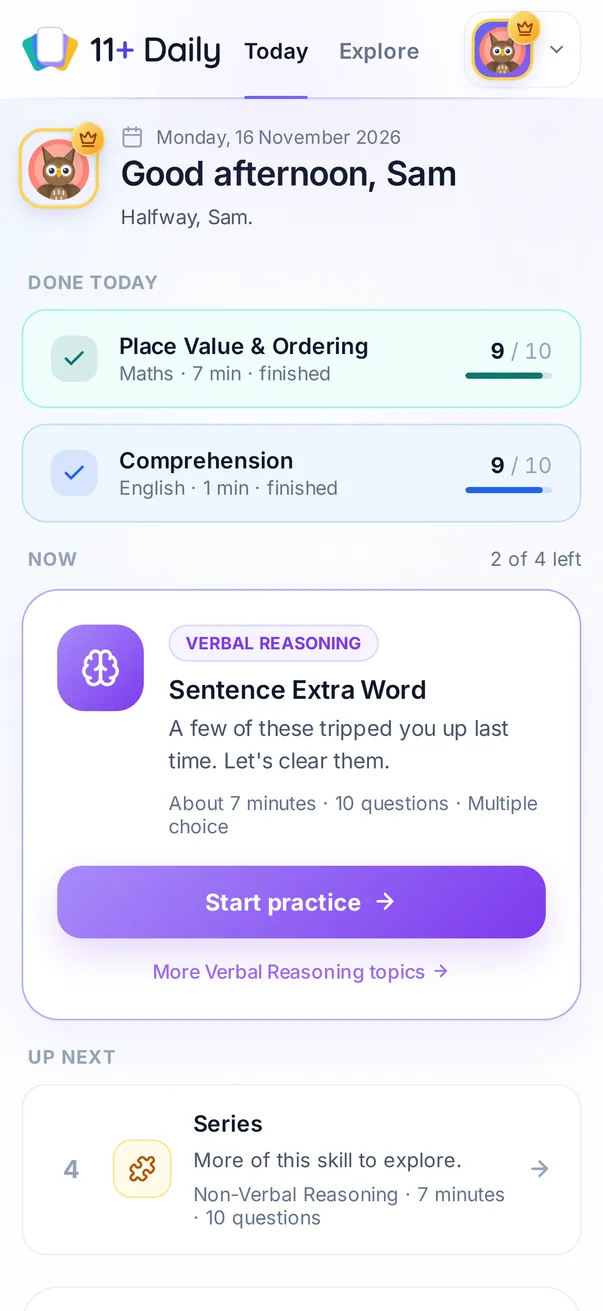
11+ Daily decides. The Today screen picks one subject and one skill, such as Spot the Punctuation Mistake, Vocab in Context or Fill the Gap, from what is weak, what has gone stale and what has not been practised yet. Questions answered wrongly come back in later sessions until they are right. Comprehension passages of fiction, non-fiction and poetry are there too, each answer explained against the text. A session takes about seven to ten minutes, with more there whenever your child wants it, and the parents area shows accuracy skill by skill. Start your free 14-day trial, with every subject unlocked and no card needed.
Try two questions from the app
One English and one Maths. Choose an answer and you will see what your child sees: whether it is right, and why.
Synonyms
What is the SYNONYM (same meaning) of:
THRIVE
Fractions of Amounts
Choose the correct answer.
A farmer has 60 eggs. He sells 3/5 of them at the market. How many eggs does he sell?
Last updated 3 November 2026.
Try 11+ Daily with your child.
11+ Daily practises the daily half of 11 plus English: vocabulary, spelling, punctuation, grammar and comprehension passages, one skill a session, with missed questions coming back until right.
14 days free, no card. Then £9.99 a month if you carry on.