The Gloucestershire FSCE 11+ test for 2028 entry: the details, and our response
Children applying to Gloucestershire grammar schools for September 2028 entry will sit the new FSCE test on 3 July 2027, at the end of Year 5. The schools' guides explain what changes for this cohort, from the subjects to practise to the way children give their answers.
The details are out
In April the seven Gloucestershire grammar schools announced that their 11 plus entrance test would move from GL Assessment to FSCE, Future Stories Community Enterprise, a not-for-profit company owned by Reading School. Our post on the Gloucestershire move to FSCE covers the announcement. The schools have published familiarisation material on their admissions pages.
There are four documents, the same on each school’s site: a Familiarisation Guide for children, one for parents, an FAQ for prospective parents, and a short information sheet on the test. You can find them on the admissions pages of The Crypt School, Pate’s Grammar School and Denmark Road High School, among others. They are free, and FSCE describes them as the only genuine resource for its test. Read them yourself: they are clear and not long.
The test is the same for all seven Gloucestershire grammar schools: Pate’s Grammar School in Cheltenham; The Crypt School, Denmark Road High School, Ribston Hall High School and Sir Thomas Rich’s School in Gloucester; and Marling School and Stroud High School in Stroud. A child sits it once, at one of the seven, and each school then applies its own admissions criteria. Each school’s name links to its places, its dates and how it offers them.
Key 11 plus dates for September 2028 entry
The test is for children who are in Year 5 now, in the 2026 to 2027 school year.
| What | When |
|---|---|
| Registration opens | Monday 8 February 2027, 12 noon |
| Registration closes | Friday 19 March 2027, 12 noon |
| Test day | Saturday 3 July 2027 |
| Results | October 2027 |
A child may take the test only once, and all of it is sat on one day at one of the Gloucestershire grammar schools. Confirm the current arrangements with the schools, because dates can change.
The date is the biggest practical change. Under GL Assessment, Gloucestershire children sat the test in September of Year 6, so this Year 5 cohort loses the summer holiday that families used to lean on.
The three FSCE papers
The Gloucestershire FSCE test is three papers, which may be sat in any order, each typically 45 to 60 minutes, with breaks between them.
- Adventure Paper: English and Maths, multiple choice.
- Beacon Paper: English and Maths, short written answers. For a number, the child writes one digit per box; for a word, one capital letter per box.
- Compass Paper: any of eleven school subjects, multiple choice. The list is Art and Design, Computing, Design and Technology, English, Geography, History, Languages, Maths, Music, Physical Education and Science.
A few details from the guides are worth knowing early. In the sample questions, multiple choice questions have four options, A to D, one of them correct, and the child shades an oval on a separate answer sheet in black pen. All instructions are given by audio recording, including the time allowed for each section. Calculators, rulers, protractors and scrap paper are not allowed, and nor is any kind of watch; there are clocks in the room. Marks are not lost for wrong answers, so a child should always put something down. The papers are marked by computer and age-standardised.
What is not in the test
This is the part that changes preparation most for a family who has been following general eleven plus advice.
- No Non-Verbal Reasoning. FSCE’s FAQ says it outright: there is no Non-Verbal Reasoning in its tests, because it is not taught in the Key Stage 2 National Curriculum.
- No Verbal Reasoning as a subject. It is not on the list.
- Nothing beyond the end of Year 5. Every question draws on the curriculum up to and including Year 5. Where a question needs something a child may not have met, FSCE says the paper supplies the information.
- No past papers, and no authorised practice papers. FSCE says the question types, subjects, content and format change from year to year, so that no tutor, parent or company can claim to know what the test will be like. The sample questions in the guides are there for format, and FSCE says they are not indicative of the content.
One detail to check with the schools: FSCE’s general FAQ mentions creative writing tasks, but the list of three papers for the Gloucestershire FSCE test names only multiple choice and short written answers.
What the guides say about English and Maths
The parents’ guide lists the skills it is looking for in each subject, and the English and Maths lists are specific.
English is heavily about grammar and meaning inside sentences: past and present tense, the progressive form, words with similar and opposite meanings, speech marks, apostrophes for plurals and possession, commas after fronted adverbials, paragraphs and cohesion, pronouns, expanded noun phrases, prefixes and suffixes, relative clauses, modal verbs, conjunctions, and homophones. The sample English question asks which of four passages suits a story for a four-year-old, so reading for audience and purpose is in there too.
Maths is the Year 5 curriculum applied to problems: numbers up to and beyond 1,000,000, negative numbers, multi-step calculation, factors, multiples, primes, square and cube numbers, fractions, decimals and percentages, measures and converting units, perimeter, area and volume, angles, line graphs, tables and timetables. No calculator, and a strong emphasis on problems in context.
What this means for a Year 5 child in Gloucestershire now
- Put the time into English and Maths. The schools say Maths and English form the main part of the assessment. Together they make up two of the three papers. How 11+ For Gloucestershire FSCE practises them is further down this page.
- Drop the reasoning papers. Time spent on Non-Verbal Reasoning, or on Verbal Reasoning puzzle types, is time not spent on the subjects FSCE lists.
- Read widely. It is FSCE’s first piece of advice for English, and it helps the Compass Paper too, which rewards a child who has paid attention across all their school subjects.
- Be wary of anything that claims to know what is on the paper. FSCE says it has authorised no commercial books or papers, and that nobody has knowledge of the test beyond the guides. We agree, and it applies to us as well.
- Plan for July, not September. The step-up that other areas make over the summer before Year 6 has to happen during Year 5. Our term-by-term Year 5 plan still applies, compressed. Deciding what to practise each day is the part 11+ Daily does for you: the Today screen picks each session from your child’s own answers.
- Use the official Familiarisation Guides. Print them and work through the sample questions with your child, so the answer sheets and the recorded instructions are not a surprise in July. For which other areas are changing provider, our guide to the GL Assessment 11 plus lists who is moving and when.
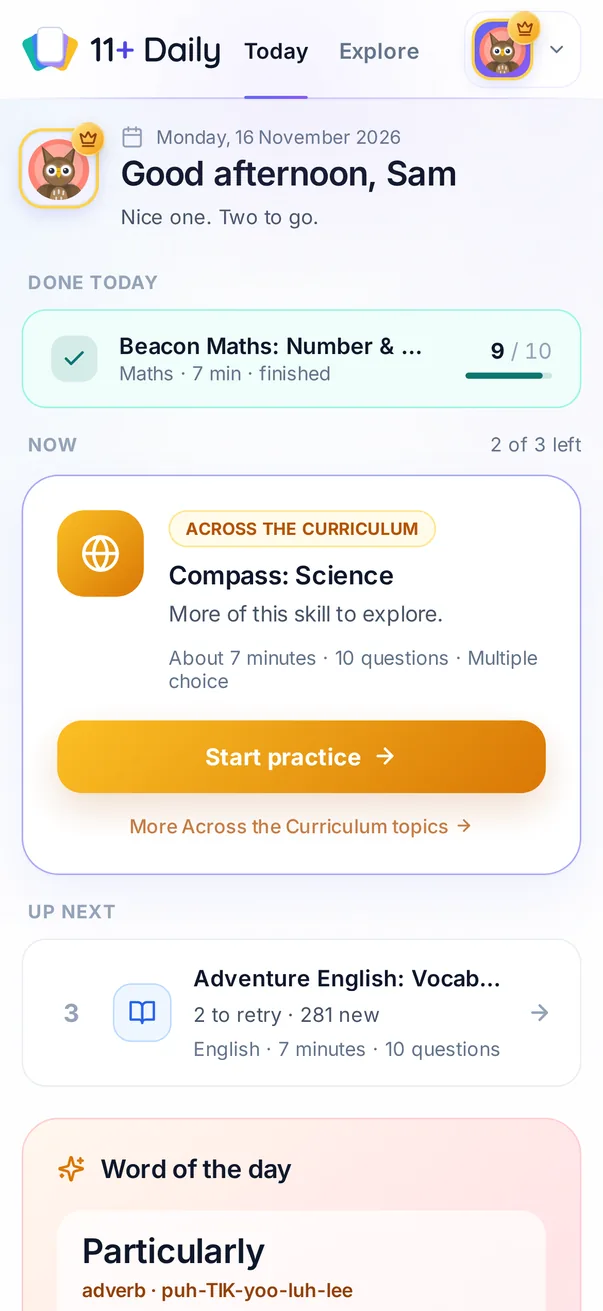
11+ For Gloucestershire FSCE
Practice set up for this test: English, Maths and the Compass subjects in short sessions, chosen for your child from their own answers. A question they get wrong comes back until they get it right.
Try two questions from the app
A Maths question answered in boxes, as the Beacon Paper asks for it, and one from Across the Curriculum, practice for the Compass Paper. Answer them and you will see what your child sees: whether each is right, and why.
Measurement
Write your answer in the boxes.
A sports match started at 2:30 pm and lasted 1 hour 40 minutes. What time did it end? Give your answer using the 24-hour clock.
Computing
Choose the correct answer.
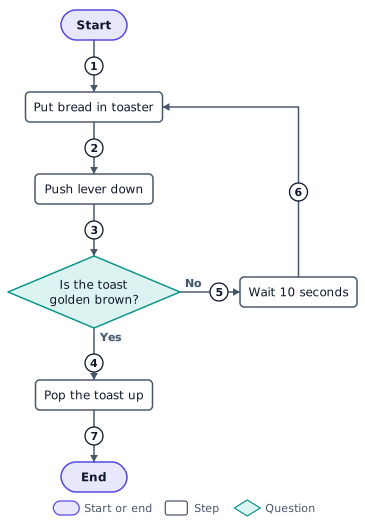
Poppy drew this flowchart for making toast, but when she follows it, more and more bread ends up in the toaster. Which arrow is in the wrong place?
Practising the part that can be practised
11+ For Gloucestershire FSCE is 11+ Daily set up for this test, with Gloucestershire FSCE 11 plus practice in English, Maths and Across the Curriculum. Every question is aimed at Year 5 or below, with no Verbal or Non-Verbal Reasoning.
Maths. The Year 5 Maths the parents’ guide lists: place value, negative numbers, the four operations, factors, multiples and primes, square and cube numbers, fractions, decimals and percentages, measures and converting units, perimeter, area and volume, angles, line graphs, tables and timetables, asked as problems in context. Each skill is practised both as multiple choice and as a written answer, one digit per box, the format the Beacon Paper uses.
English. Grammar inside sentences, spelling and vocabulary, and reading with passages, again as multiple choice and as written answers, one capital letter per box, plus punctuation as multiple choice. A word of the day runs alongside, to stretch vocabulary.
Across the Curriculum. Practice for the Compass Paper in the nine subjects it lists beyond English and Maths: Art and Design, Computing, Design and Technology, Geography, History, Languages, Music, Physical Education and Science, kept familiar a little at a time.
Each time your child opens it, the Today screen picks one subject and one skill for a session of about ten minutes, with more there when they want it, and a question answered wrongly comes back until it is right. In the parents area you can see which skills your child has practised and how accurately they answered. FSCE has authorised no practice material from anyone, us included: every question is original to 11+ Daily, not FSCE material.
After you sign up, set the exam board to FSCE Gloucestershire. Start your free 14-day trial, with every subject unlocked and no card needed.
Last updated 18 November 2026.
Try 11+ Daily with your child.
11+ Daily has a version set up for the Gloucestershire FSCE test, 11+ For Gloucestershire FSCE: English and Maths, already planned in short sessions, practice for the Adventure and Beacon Papers, and Across the Curriculum, practice for the Compass Paper. After you sign up, choose FSCE Gloucestershire as the exam board.
14 days free, no card. Then £9.99 a month if you carry on.