11+ mock exams: when to start them and how many to do
A mock paper and daily practice are different jobs, needed in very different amounts. This is when to start full papers, how many is enough, and how to get the learning out of each one.
Daily practice and a mock paper are different jobs
Most of the 11 plus preparation your child does should be short and frequent: ten to thirty minutes on one skill, most days. That is where knowledge is built. A mock paper is a different thing: a full paper, sat in one go at a table, under the real time limit, with no help, marked afterwards.
A mock is not a bigger practice session. Daily practice builds what your child knows; a mock trains how they deliver it on the day. You need both, in very different amounts. We set out the daily side in how much 11 plus practice a child needs each day; this post is about the other half. If you are new to the test itself, start with what the 11 plus is, in plain terms.
What a mock actually trains
A mock does not teach knowledge. If your child cannot do a ratio question on Tuesday evening, they will not learn it by meeting it in a timed paper on Saturday. What a mock trains is everything around the knowledge.
- Pace. 11 plus papers leave little time per question. Children who know the content still lose marks by spending four minutes on one they could not do.
- Stamina. Concentrating for the best part of an hour, then doing it again after a short break, is a skill in itself, and ten-year-olds have rarely done it.
- The answer sheet. In many paper tests the child marks answers on a separate sheet. It is easy to skip a row and put every later answer one line out. Practising with a real one makes it automatic. Confirm the format your area uses.
- Nerves. Sitting in silence with a clock and no one to ask is unfamiliar. It gets less frightening with rehearsal, and only with rehearsal.
When to start 11 plus mocks: around March of Year 5
For most families in areas where the eleven plus is sat in September of Year 6, a sensible time to start full papers is around March of Year 5. Before that, most children have not covered enough for a full paper to be informative. A mock done too early gives a low score that says only “not yet”, and it can put a child off for months.
From March, one full paper a month is enough. That gives five or six papers across the spring and summer term, each a checkpoint rather than the main event. For a shorter first try, our free 11 plus practice papers in English and Maths are 25 questions in 25 minutes, with every answer explained.
In the final month before the exam, which for a September test is the August holiday, step up to a full paper most weekends. This is the only window in which heavier mock practice earns its place, because the aim has shifted from learning to exam fitness. Confirm your area’s test date with the admissions authority and shift the timeline to match. Our term-by-term plan for Year 5 shows where the mocks sit alongside everything else.
How many in total
That adds up to somewhere between eight and twelve full papers, and for most children it is plenty. Each paper after the first few adds less than the one before, and every Saturday spent on a mock is a Saturday not spent on the skills the last mock exposed. Weekly mocks early on rarely help and often crowd out the daily work.
The review is where the learning is
A mock that is marked, scored and put in a drawer has done a quarter of its job. The review is where a child learns something, and it deserves as long as the paper itself.
Mark it the next day, with your child, rather than straight afterwards when they are tired and defensive. Sort every wrong answer into one of four piles:
- Did not know how. A genuine gap. Note the topic; it goes into the daily practice for the next fortnight.
- Knew how, slipped. A misread, a careless calculation, the right working and the wrong box. Slips clustered at the end of a section usually mean rushing.
- Ran out of time. Blank answers at the end. This is a pace problem, and the fix is practice at moving on, not more content.
- Guessed right. Harder to spot, but ask. A right answer the child cannot explain is not yet a right answer.
Then have your child redo the first two piles untimed; most of the second pile will come right at once, which shows the knowledge is there. Keep a simple log: date, paper, score, and the topics in the first pile. Over three or four papers the log tells a clearer story than any single score, and our guide to what 11 plus standardised scores mean explains why a practice percentage is not a prediction of the real result.
The first pile is the one that needs daily work, and keeping it on the list for a fortnight is easy to let slip. In 11+ Daily, a question answered wrongly comes back in later sessions until it is right, and the Today screen picks each session from what is weak, so the gaps keep coming round without you planning it.
When the score goes down
At some point a mock score will fall, and it will feel alarming. It usually is not. The usual causes are fatigue, a harder paper than the last one, and an ordinary bad day. Practice papers from different publishers are not calibrated against each other, and even papers within one series vary. A drop of a few marks is noise.
Children do not forget in a month what they spent six months learning. If scores fall as you add workload, though, take that as a signal about the workload. The right response is almost always to do less for a week or two, not more.
Formal mock events: one or two, near the end
Tutoring companies and some local groups run mock exam days, usually in a school hall, with an invigilator, printed papers and answer sheets, and a room full of strangers. They reproduce the one thing a home mock cannot: the setting. For a child who has never sat anything like the real thing, one or two of these in the last couple of months can take the strangeness out of the day.
The case against doing many is straightforward: they cost money, they are tiring, they usually come with a ranked score that invites comparison, and after the second one your child is not learning anything new about the conditions. Treat them as a rehearsal of the room, not a measure of the child.
Running a mock at home: a checklist
- A quiet room and a clear table, door shut, siblings elsewhere.
- Real timing, with a visible clock, and sections timed separately if the paper has them.
- The answer sheet the paper comes with, or a printed one in the format your area uses, so transferring answers is practised too.
- Pencil, rubber and nothing else on the table.
- No help. If your child asks a question, the answer is “do your best and move on”, which is what they will hear on the day.
- A short break between papers if there are two, as many real tests have.
- Mark it together the next day, sort the wrong answers into the four piles, and log the topics.
Mocks for the conditions, daily practice for the gaps
Every mock review ends with a list of topics to practise and a log to keep. The hard part is the weeks in between: deciding what to practise each day and remembering which topics the last paper showed up.
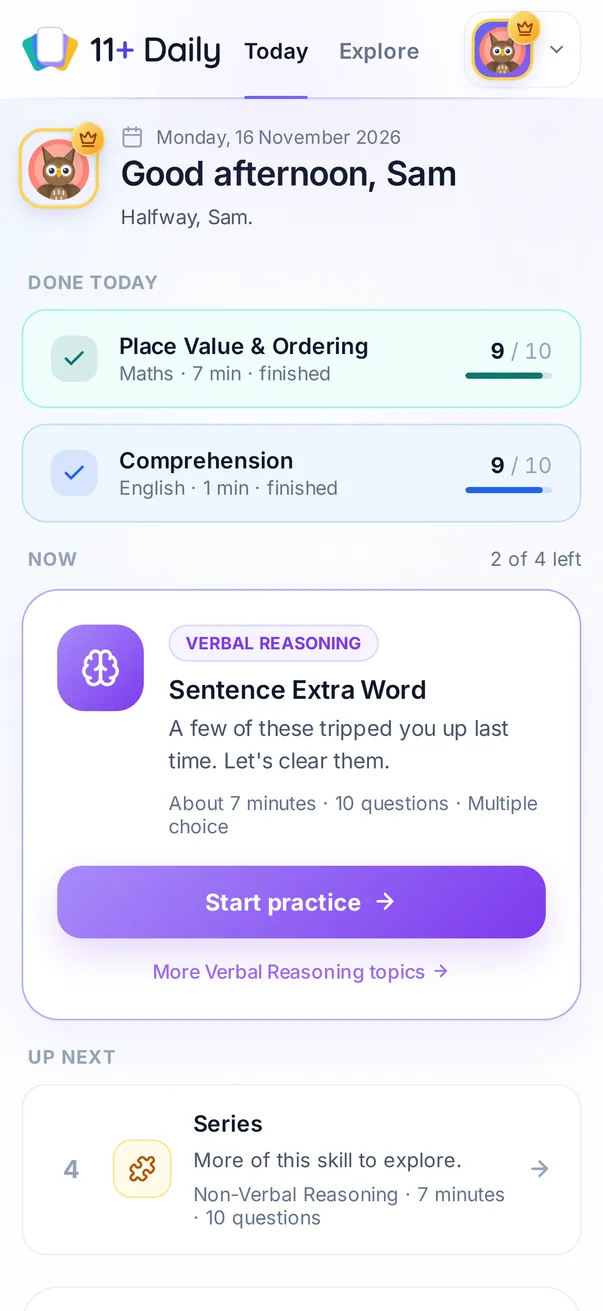
11+ Daily does that part. The Today screen picks one subject and one skill for each session, about seven to ten minutes, with more there whenever your child wants it. Wrong answers come back in later sessions until they are right, Weak Points gathers the questions your child keeps missing into one drill, and the parents area shows accuracy by subject and by skill, so you can see whether the gaps from your last review are closing. It has no full mock papers, since a mock needs paper, a table and a clock; Quick Test gives short, targeted practice with optional timing. Start your free 14-day trial, with every subject unlocked and no card needed.
Try two questions from the app
One English and one Maths. Choose an answer and you will see what your child sees: whether it is right, and why.
Synonyms
What is the SYNONYM (same meaning) of:
THRIVE
Fractions of Amounts
Choose the correct answer.
A farmer has 60 eggs. He sells 3/5 of them at the market. How many eggs does he sell?
Last updated 26 October 2026.
Try 11+ Daily with your child.
11+ Daily does the work between mocks: it picks short sessions on the skills your child is weak in and brings back what they got wrong, so each review turns into practice.
14 days free, no card. Then £9.99 a month if you carry on.