GL 11+ Non-Verbal Reasoning question types, and how to answer each one
Non-Verbal Reasoning is the subject parents feel least able to help with, because there is nothing to look up and the rule is never written down. It is also one of the more learnable parts of the test, because only a small number of things ever change.
What Non-Verbal Reasoning actually is
Non-Verbal Reasoning is the part of the 11 plus that is drawn rather than written. In GL papers each question shows a set of figures with a rule hidden inside them and five options, exactly one of which obeys it. Beyond one line of instruction there is nothing to read, so a child whose vocabulary is still building is not held back here as they can be in Verbal Reasoning or English.
It is also the subject parents feel least able to help with, and that is normal. A vocabulary question can be settled with a dictionary; a maths question can be done on paper. Here the rule is never stated, and it is common for an adult to stare at a row of shapes and see nothing. The most useful thing a parent can do, further down this post, does not need you to see the rule.
GL papers build Non-Verbal Reasoning from a small set of formats that recur year after year, which is the argument running through why the GL 11 plus is learnable. Not every 11+ test has it: Essex’s CSSE papers are English and Maths, and the Gloucestershire FSCE test, from 2028 entry, has no Verbal or Non-Verbal Reasoning. Confirm the current arrangements with the admissions authority, and the GL Assessment 11 plus has who is moving provider and when.
The short list of things that ever change
Almost every question turns on the same handful of properties. Learning the list is worth more than volume, because it turns staring into checking. For where Non-Verbal Reasoning sits in the test as a whole, see what the 11 plus is.
- Shape, and the number of sides
- Count: small shapes, dots, lines, tick marks
- Shading: white, solid black, diagonal hatching, upright lines
- Line style: solid, dashed, thin, thick
- Turning: a quarter, a half or three-quarters, clockwise or anticlockwise
- Flipping: a mirror image, most often left to right
- Size, and which of two things is bigger
- Position: inside, outside, touching, at a corner, in a row or column
- Direction: which way an arrow or a point faces
- Symmetry: mirror lines, and whether one half mirrors the other
A turn and a flip are different, and on a symmetrical shape they look identical, so the tell is an asymmetric detail such as a dot or an arrowhead. Two or three of these properties usually change at once, which is what the wrong options are built for.
The eight question families
Eight formats recur, and each carries its own trap.
Series
Five figures sit in a row with one box empty. Something changes from each figure to the next, usually more than one thing: the outer shape may run square, circle, triangle and repeat while the inner arrow turns a quarter clockwise each step and swaps between solid and hollow.
The empty box is not always the last one. It can sit anywhere in the row, including the very start, where the rule has to be run backwards. Compare each figure with the one before it, note every change, check the rule holds at every step, then build the missing figure in your head before reading an option. Worked examples are on our Series questions page.
Complete the Grid
A grid of figures has one square blank, most often three boxes across and three down, sometimes two by two. A rule runs across each row and another down each column, and the answer obeys both at once: the row might decide which way the arrow points while the column decides its colour, or each row and column might use every shape once and every fill once.
The classic wrong option finishes the row and breaks the column, so read across, read down, then check against both. A two by two grid gives only one other row and one other column to learn from, so use both. This is not the Verbal Reasoning Word Grid, which is a two-by-three grid of words with themed rows and linked columns. Worked examples are on our Complete the Grid questions page.
Complete the Pair
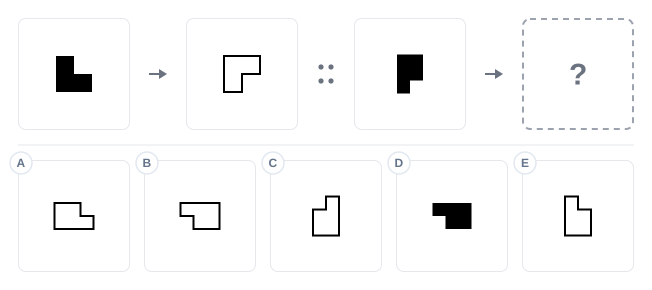
The first two figures form a pair: the second is the first after something has been done to it. Work out what changed, do the same to the third figure, pick the result. The changes are the ordinary ones: a quarter-turn clockwise, a flip left to right, a fill swapping from solid to an outline or to diagonal hatching, an outline growing thicker, a dot appearing at a corner.
This is where stacked changes catch children most: some pairs turn the shape, swap its fill and add a mark at once, and an option that gets two of those three right is still wrong. Name every change from the first figure to the second, out loud, before you look at the third. Worked examples are on our Complete the Pair questions page.
Odd One Out
Five figures sit in a row. Four obey a rule and one breaks it. The rule is usually a relationship rather than a look: the small black shape has the same number of sides as the big dashed one, or the arrow and the dot always have opposite fills. One good set shows the same black shape turned to five angles, with the odd one a mirror image that no turning will match.
Ask what four of them share before asking which looks strange. The one that looks most different at a glance is often there to catch that instinct, and a detail that differs in all five carries no rule. Note that this is not the Verbal Reasoning family called Two Odd Ones Out, where three of five words share a connection and the two left over are the answer. Worked examples are on our Odd One Out questions page.
Find Like First Two and Find Like First Three
The same question with one difference, and the pair most often confused. In both, the example figures share a single property that is never written down, and exactly one of the five options shares it too. The only difference is how many examples you are given, two or three, and that difference is the point of having both. Three examples pin the rule down; two leave room for coincidence, so a feature they happen to share by accident looks exactly like the real rule.
The properties are precise and often relational: a hexagon with a circle fully inside it, hatched rather than solid; exactly two arrows of the same length with matching heads. The answer often uses a shape found in neither example, because what is fixed is the property, not the look. Say that property as a full sentence, then take it to the options one at a time. If a candidate rule fits three of the five it is not the rule; if two survive, there is a feature you have not used. Our page on Find Like First Two questions describes real questions in words, and so does the one on Find Like First Three questions.
Horizontal Code and Vertical Code
The other pair that gets muddled, and again the reasoning is identical. Key figures each carry a letter code, every letter stands for one property, the same letter always means the same thing, and the child builds the code for the figure that has none. The difference is the shape of the code, not the thinking: Horizontal Code uses exactly two letters, set one above the other beside the figure, so the options are pairs of lettered boxes, while Vertical Code writes the code as a run of two or three letters, so the options are letter strings.
Find two key figures that share a letter, because what they have in common is what the letter means. Work out what each position controls, then read the new figure position by position, keeping the order. Never assume the first or top letter is the shape: it is whatever the key says, and as likely to be the fill, the number of dots, or whether the inner shape matches the outer one. With three letters, the third property is usually the one nobody checked. Each has its own page of worked examples: Horizontal Code questions and Vertical Code questions.
The mistakes that cost the most marks
- Working backwards from the options, picking whichever looks about right instead of naming the rule first.
- Stopping at the first rule found, when most figures carry two or three changes at once.
- Counting once. Dots, sides and tick marks are miscounted under time more than anything else.
- Choosing the near copy, the option that closely resembles an example but breaks the rule in one small way.
The same habit of naming the format before answering is what makes the GL Verbal Reasoning question types manageable too.
How to practise 11 plus Non-Verbal Reasoning
This is where a parent who cannot see the rule turns out to be useful. Ask your child to say the rule as a full sentence before they touch an option, and judge the sentence rather than the answer. You do not need to see the pattern to hear whether a sentence can be tested: “it turns a quarter clockwise each step and gains one dot” can be checked against every figure on the page, and “it looks right” cannot be checked by anybody.
Beyond that, four things.
- One family at a time, untimed, until the routine is automatic. Ten questions on Complete the Pair teach more than forty mixed ones.
- When an answer is wrong, do not hand over the right one. Ask what their option got right and which part of the sentence it broke.
- Mix the families only once each is secure. Recognising the type when nothing tells you is a separate skill, invisible while every page is labelled.
- Add the clock last. Pace built on an unreliable method trains faster guessing. Our guide to how much 11 plus practice a child needs each day has the pattern.
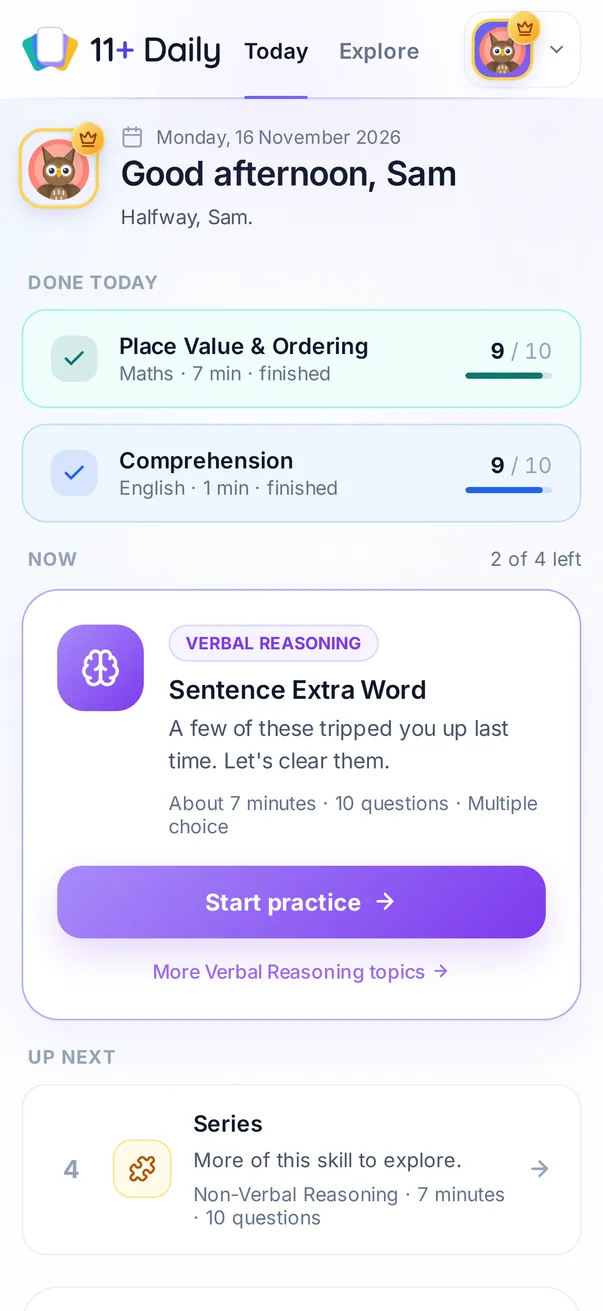
Points 1 and 2 are the part 11+ Daily does for you: every session stays on one family, and a figure answered wrongly comes back in a later session until it is right. You can see how the Today screen picks each session.
All eight are walked through in plain language, with figures drawn as a child meets them, on our Non-Verbal Reasoning practice page. And check whether your own eleven plus area sets this paper before building a term around it. If you are helping at home and cannot see the rule yourself, our guide to how to help your child with Non-Verbal Reasoning shows a question solved one rule at a time.
All eight Non-Verbal Reasoning families, practised in the right order
The hard part of the routine above is keeping track: which family comes next, which one was shaky last week, and whether Vertical Code has been touched at all. 11+ Daily has a skill for each of the eight families, and the Today screen picks one subject and one skill per session from what is weak and what has not been practised for a while, so one family at a time happens without you planning it. Wrong answers come back until they are right, and Weak Points gathers the ones that keep slipping. The parents area shows accuracy skill by skill, so you can see which family needs work without seeing the rule yourself. A session is about seven to ten minutes, with more there when your child wants it. Start your free 14-day trial, every subject unlocked and no card needed.
Try two questions from the app
One Verbal and one Non-Verbal Reasoning. Choose an answer and you will see what your child sees: whether it is right, and why.
Related Words
Complete the word analogy:
kangaroo is to (hop marsupial joey) as dolphin is to (swim pod mammal)
Group 1
Group 2
Complete the Pair
Choose the correct answer.
Find the missing figure that completes the pair.
Last updated 10 November 2026.
Try 11+ Daily with your child.
11+ Daily gives your child Non-Verbal Reasoning one question family at a time, picks which family comes next, and brings back every figure they got wrong until it is right.
14 days free, no card. Then £9.99 a month if you carry on.