The 11+ and SATs: what is the difference?
No, they are not the same test. SATs are the national tests every child in an English state primary sits in May of Year 6, and nobody passes or fails them. The 11 plus is an optional entrance test for grammar schools, usually sat in September of Year 6, months before SATs. They share some maths and English and not much else.
Two tests in the same year, for different purposes
If your child is in Year 5 or Year 6 in England, two tests are on the horizon and they are easy to confuse. The 11 plus is an entrance test for selective schools, sat by children whose parents choose to enter them. SATs are the statutory Key Stage 2 tests that every child in a state primary sits at the end of Year 6. They fall in the same school year, they cover some of the same maths and English, and they are otherwise quite different.
If you are still weighing up whether to enter your child at all, start with what the 11 plus is and who sits it.
What SATs are
SATs are the national tests taken at the end of Key Stage 2. Every child in an English state primary, including academies, sits them in May of Year 6, in school. They test three things: English reading; English grammar, punctuation and spelling; and maths. Writing is assessed by the teacher rather than by a test, and science is tested only in a sample of schools in some years. Confirm the current arrangements with the school, as details change.
Results are reported as scaled scores. Raw marks are converted onto a scale on which 100 is the expected standard for the end of Key Stage 2; at the time of writing the scale runs from 80 to 120. A child who scores 100 or above has met the expected standard, and a higher score shows they are working above it. Nobody passes or fails, and no admissions decision rests on the result. The scores usually reach you in July, through the school.
What the 11 plus is
The 11 plus is an optional test used for admission to selective state grammar schools and, in a somewhat different form, some independent schools. Your child sits it only if you apply. In most grammar school areas it is sat in September of Year 6, with results in October before the deadline for secondary applications. Some areas test a little later, many independent schools test in January, and the Gloucestershire FSCE test is sat in the summer of Year 5. Confirm the date with the admissions authority for your area.
The test is set by a test provider or a consortium of schools, not by the government. The most widely used provider is GL Assessment, and our guide to GL Assessment and the 11 plus explains its formats. Depending on the area it covers up to four subjects: English, maths, verbal reasoning and non-verbal reasoning. In most areas the questions are multiple choice, answered on a separate answer sheet, and the timing is tight; some areas ask for written answers.
Results are reported as standardised scores, which compare your child with the other children who sat the same test, adjusted for age. The admissions authority then applies a qualifying score or a rank order to decide who is offered a place. We explain this in what 11 plus standardised scores mean.
Where the two overlap, and where they do not
The maths and English in the 11 plus draw on the same Key Stage 2 curriculum that SATs test. Fractions, decimals and percentages, place value, ratio, geometry, reading for meaning, spelling, punctuation and grammar are in scope for both. A child who is secure in Year 5 maths and reads widely has a foundation that serves both tests. The differences are what catch families out.
- Reasoning. Verbal and non-verbal reasoning are not taught in most primary schools and are not in SATs at all, yet they make up a large part of many 11 plus tests (not all: the Essex and Gloucestershire FSCE tests have none). Our guides to verbal reasoning question types and non-verbal reasoning question types show what they look like.
- Multiple choice. SATs mostly ask for written answers, with working shown in maths. Most 11 plus papers are multiple choice, marked on a separate sheet. That format rewards eliminating wrong answers and punishes losing your place on the sheet, and neither is practised at school.
- Time pressure. The 11 plus is timed tightly so that scores spread out, and many children do not finish every section. SATs measure against a fixed standard, so pace matters far less.
- Purpose. SATs measure a child against a standard. The 11 plus ranks a child against other children, so a good 11 plus score depends on who else sat the test that year.
- Timing in the year. By the time SATs arrive, a child has had two more terms of Year 6 teaching. The 11 plus is sat before that teaching, so content a school covers in Year 6 has to be met earlier if it is to be in place for the test. Our maths topics in the order they come up is built around that.
Why a child doing well at school can still find the 11 plus unfamiliar
Parents are often surprised when a child who is working above the expected standard at school comes home from a first practice paper bewildered. Nothing is wrong with the child: the test is asking for things school has not taught.
A child at the top of their class has probably never seen a letter series or a shape analogy, never transferred answers to a separate sheet, and never been asked to do so many questions in so little time. School has taught them the content but not the format, the reasoning or the pace. All three are learnable, and they are most of what preparation is.
Why 11 plus preparation helps SATs, and not the other way round
Preparing for the eleven plus means covering Key Stage 2 maths and English early and practising it more thoroughly than the school timetable requires. A child who has done that arrives in the spring of Year 6 already familiar with most of what the SATs papers ask, and the vocabulary work helps with the reading paper.
The reverse does not hold. School SATs preparation happens in Year 6, after most 11 plus tests have been sat, and it does not touch reasoning or the multiple-choice format. Doing well at school is a good start, not preparation.
What this means for your year
Year 4. Nothing needs to happen for SATs, and only light exposure makes sense for the 11 plus. Our post on starting 11 plus preparation in Year 4 sets out what light means.
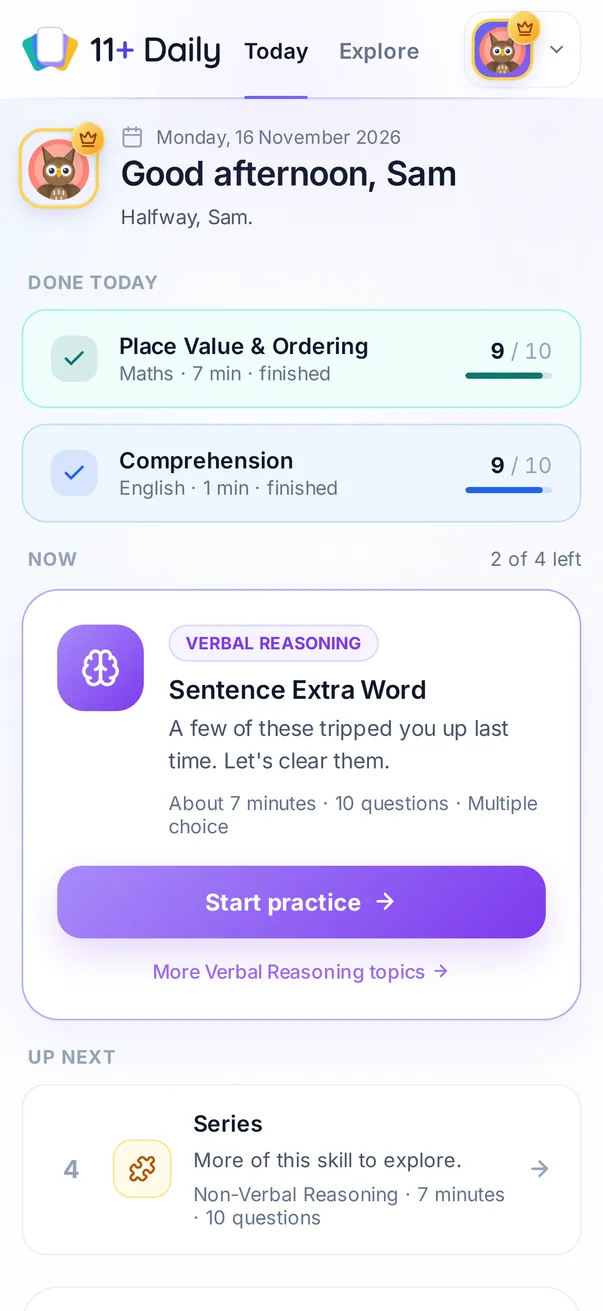
Year 5. This is the substantive 11 plus year. In most areas the test is sat within weeks of Year 6 beginning, and school will not have started on SATs, so the maths and English work is on you. Deciding what to practise each day is the part 11+ Daily takes on: the Today screen picks one subject and one skill from what is weak and what has not been practised for a while. Our term-by-term Year 5 plan and our guide to preparing without a tutor cover it.
Year 6. The 11 plus comes first, in September in most areas, with results in October and secondary applications due at the end of October. Then the year turns to SATs, and the school leads. The work already done for the 11 plus carries over, so a child who has prepared properly usually needs little extra for May. Offers of secondary places arrive on 1 March, before SATs are sat. Confirm those dates with the school and the admissions authority; they vary and they change.
One daily habit that serves both tests
The overlap is the useful part: Key Stage 2 English and Maths, met early and practised often, help in September and again in May, and the reasoning covers what SATs leave out. 11+ Daily turns that into a short daily habit. The Today screen picks one subject and one skill for each session of about seven to ten minutes, with more there when your child wants it, and tells them why. Wrong answers come back until they are right, and Weak Points gathers the questions they keep missing into one drill. You see days practised, skills covered and accuracy by subject and skill in the parents area, without asking. Where your area’s test has no reasoning, switch Verbal and Non-Verbal Reasoning off in Settings. Start your free 14-day trial, every subject unlocked, no card needed.
Try two questions from the app
One English and one Maths. Choose an answer and you will see what your child sees: whether it is right, and why.
Synonyms
What is the SYNONYM (same meaning) of:
THRIVE
Fractions of Amounts
Choose the correct answer.
A farmer has 60 eggs. He sells 3/5 of them at the market. How many eggs does he sell?
Last updated 3 November 2026.
Try 11+ Daily with your child.
11+ Daily practises the Key Stage 2 English and Maths both tests draw on, plus the reasoning SATs leave out, one skill a day picked by the Today screen.
14 days free, no card. Then £9.99 a month if you carry on.